
About the Author:
Jeff Nunn is the founder of Project Biohacking. With over 30 years of biohacking practice, he applies decades of self-experimentation methodology to peptide research, dosing math, and vendor evaluation.
Why the longevity protein Klotho is moving from animal studies to biohacking stacks, and what the current research actually shows.
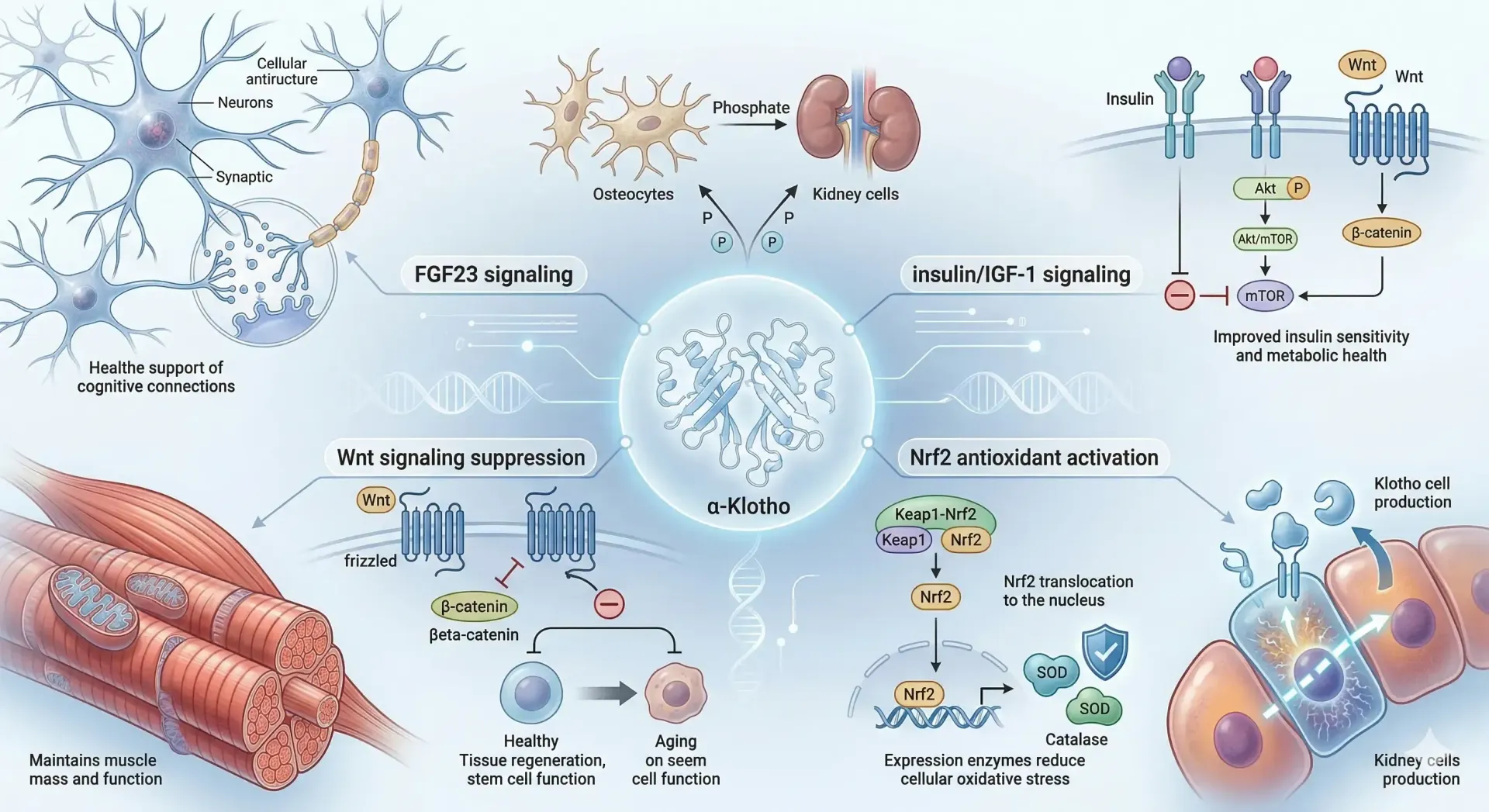
Alpha-Klotho is a protein produced primarily in the kidneys that circulates in a soluble form throughout the body. It functions as a co-receptor for FGF23 signaling, plays a role in phosphate and calcium metabolism, and exerts downstream effects on insulin sensitivity, oxidative stress response, and tissue aging. Serum Klotho levels decline measurably with age, and that decline has been associated with a range of age-related outcomes including cognitive impairment, sarcopenia, vascular calcification, and systemic inflammation.
That profile makes it an obvious target for longevity-oriented researchers and biohackers. The question driving most of the current interest is whether artificially elevating Klotho activity, either through protein supplementation or engineered peptide constructs, can slow or reverse any of those age-associated processes.
Soluble alpha-Klotho is a large protein. That size creates practical problems for injectable applications: poor bioavailability, rapid clearance, and significant manufacturing complexity. Full recombinant Klotho protein has been tested in preclinical models with compelling results, but translating that into a stable, injectable compound for human-adjacent use has remained a substantial technical hurdle.
Modified peptide constructs address some of those limitations. Engineered Klotho peptides, typically shorter sequences derived from the Klotho protein's active regions, are designed for improved stability and extended half-life. Albumin-binding modifications, for example, allow the peptide to attach to circulating albumin in the bloodstream, which slows clearance and extends the window of biological activity. These constructs are currently available as research-grade compounds from suppliers like Biolongevity Labs, where they are sold strictly for laboratory and research use.
Klotho's biological influence is broad, which is part of what makes it interesting and part of what makes it difficult to study cleanly. The mechanisms currently being investigated include:
Animal studies form the core of what is currently known about Klotho's effects at elevated levels. Mice engineered to overexpress Klotho have shown lifespan extension in the range of 20 to 30 percent, along with improved metabolic markers and reduced tissue aging. Conversely, Klotho-deficient mice develop a phenotype that closely resembles accelerated aging.
More relevant to biohacking interest are intervention studies rather than genetic models. Research using soluble Klotho injections in aging rodents has shown improvements in muscle mass retention, bone density, and markers of neuroinflammation. A frequently cited nonhuman primate study demonstrated that a single low-dose administration of soluble Klotho produced measurable improvements in working memory in aging animals. That result, while preliminary and limited to a small study population, has been widely referenced in longevity communities as evidence of cognitive potential.
A 2025 study in aging mice using a one-time treatment approach reported improvements across multiple tissue types simultaneously, including muscle, bone, and brain function, alongside a roughly 20 percent extension in remaining lifespan. Results of that nature in animal models generate significant interest, though the translation to human physiology remains unproven.
The transition from preclinical evidence to human data is underway, though early.
Klothea Bio is developing AKL003, an mRNA-based therapeutic that uses lipid nanoparticles to deliver alpha-Klotho mRNA intravenously. As of early 2026, a Phase 1b trial is assessing safety, tolerability, and serum Klotho elevation in healthy adults across a broad age range. This represents one of the first efforts to systematically evaluate Klotho augmentation in humans.
Minicircle, a gene therapy company, is running a trial combining Klotho and follistatin gene constructs via subcutaneous, non-viral plasmid delivery. The trial focuses on cognition, epigenetic aging markers, and overall healthspan outcomes in healthy adult participants.
Klotho Neurosciences, which trades on NASDAQ under the ticker KLTO, is advancing secreted Klotho (s-KL) as a candidate for neurodegenerative disease indications, with presentations at biotech forums in early 2026.
None of these trials have produced published efficacy data in humans. All remain in early safety and feasibility phases.
In the absence of approved human therapeutics, biohacker interest has concentrated on research-grade injectable Klotho peptide constructs. These are not approved for human use and are not intended to be. The compounds available through research suppliers represent engineered peptide fragments, not full Klotho protein, and their pharmacokinetics and safety profiles in humans are not established through clinical trial data.
Vendors supplying the research market, including Biolongevity Labs, offer AlphaKlothoLR and other alpha-Klotho peptide variants at documented purity levels with third-party testing. Biohackers who follow source quality in the research peptide space treat third-party certificate of analysis documentation as a baseline requirement. The current Biolongevity Labs coupon code and the full testing review are both in our directory.
Interest in Klotho peptides has also grown in the context of combination approaches. Some longevity-focused researchers are exploring Klotho alongside follistatin-related compounds for potential muscle and cognition synergies, though this remains speculative and outside any established research framework.
Of all the areas where biohackers are focused, cognition draws the most consistent attention. The aging brain loses synaptic density, increases in neuroinflammatory activity, and accumulates the kind of cellular stress that Klotho's known mechanisms appear to counteract. Hippocampal function specifically, which underlies memory consolidation and spatial reasoning, shows Klotho-responsive changes in animal models.
Whether those changes translate to meaningful cognitive outcomes in humans is the key unanswered question. The primate data provides directional evidence. The human trial designs being used by Klothea Bio and Klotho Neurosciences suggest that researchers consider the signal worth pursuing at significant investment. For now, the biohacking community is operating ahead of that data curve.
The second major target is sarcopenia, the progressive loss of skeletal muscle mass that accelerates in the fifth decade of life and contributes substantially to functional decline in aging populations. Klotho's role in muscle biology involves both direct effects on muscle progenitor cell activity and indirect effects through its modulation of inflammation and oxidative stress, both of which impair muscle repair and regeneration.
Preclinical data showing sarcopenia reversal following Klotho elevation have been replicated across multiple study designs. The mechanisms are consistent with what is known about Klotho's pathway activity. This makes muscle preservation one of the more biologically coherent targets for Klotho research, even if human data remains absent.
Injectable Klotho peptide research is at an inflection point. The foundational animal data is compelling enough to justify human trials, and those trials are now running. The biohacking community is moving ahead of that trial timeline, as it typically does with research-grade compounds that have strong preclinical signal and accessible sourcing.
The next meaningful developments will come from the Klothea Bio Phase 1b readout and the Minicircle trial data, both of which are expected to produce initial safety and biomarker data within the next one to two years. How those results land will determine whether Klotho moves into mainstream clinical development or remains a longevity research target with an engaged but self-experimenting user base.
Alpha-Klotho is not a compound where source quality is optional. Because the engineered peptide constructs circulating in the research market vary significantly in purity, stability, and albumin-binding characteristics, the difference between a tested batch and an untested one shows up directly in whether the compound behaves as expected at the bench. Third-party HPLC and mass spectrometry data matched to the specific lot number is the minimum bar.
Biolongevity Labs is the vendor most commonly referenced in the Klotho research peptide space because they stock AlphaKlothoLR as a standing SKU rather than an intermittent drop, publish per-batch certificates of analysis, and manufacture within the US. To review their current testing documentation and pricing, use the verified Biolongevity Labs discount code for an additional 15% off at checkout, it stacks on any existing promotions.
For researchers building broader bioregulator stacks around Klotho, the same vendor also carries Cartalax, Epitalon, Pinealon, and Vilon peptides, see the full Biolongevity Labs review and catalog breakdown for comparative pricing and current availability. Of those, Vilon is the thymus and immune-aging member of the Khavinson set, studied for how it shifts gene expression in aging immune cells. See the full guide to the Vilon KE immune-aging bioregulator.
For those tracking this space through a sourcing and quality lens, theProject Biohacking peptide dosage calculator provides a structured tool for working through research compound parameters.
This page may contain affiliate links. We only recommend vendors whose third-party testing documentation we've independently verified.
Injectable Klotho peptide refers to engineered peptide constructs derived from the alpha-Klotho protein, designed to mimic or enhance its biological activity. These compounds are sold as research-grade materials and are not approved for human therapeutic use.
Alpha-Klotho declines with age, and that decline correlates with accelerated aging markers including cognitive impairment, muscle loss, and systemic inflammation. Animal models with elevated Klotho levels have shown extended lifespan and improved tissue function, driving interest in Klotho augmentation as a longevity strategy.
In animal models, elevated Klotho levels have been associated with improved cognitive function, reduced sarcopenia, better bone density, suppressed neuroinflammation, and extended lifespan. The mechanisms involve FGF23 signaling, insulin pathway modulation, Wnt suppression, and Nrf2 and FoxO pathway activation.
Yes. As of early 2026, Klothea Bio is running a Phase 1b trial of an mRNA-based Klotho therapeutic in healthy adults, and Minicircle is conducting a trial using a non-viral gene delivery approach combining Klotho and follistatin. Both are in early safety phases without published efficacy data.
Soluble Klotho is the full-length protein, which has bioavailability and stability challenges as an injectable. Modified Klotho peptides use shorter engineered sequences with structural modifications such as albumin binding to improve half-life and pharmacokinetics.
Research-grade injectable Klotho peptide constructs are available from suppliers such as Biolongevity Labs, which provides USA-manufactured compounds with third-party certificate of analysis documentation. These are available for research use only and are not intended for human administration.

About the Author:
Jeff Nunn is the founder of Project Biohacking. With over 30 years of biohacking practice, he applies decades of self-experimentation methodology to peptide research, dosing math, and vendor evaluation.
Important Disclaimer: The content on Project Biohacking is for educational and informational purposes only and is not intended as medical advice, diagnosis, or treatment. Always consult a qualified healthcare professional before making any changes to your health regimen, starting new supplements, peptides, or protocols. Nothing on this site establishes a doctor–patient relationship, and you use the information at your own risk. Research compounds discussed here are sold for laboratory research purposes only and are not approved for human or veterinary use or consumption.
“For educational use only. Not medical advice. Read our full disclaimer.”
+1 214-278-4039
All Rights Reserved | Project Biohacking