

Ameano Peptides Review

3.2 / 5

Standards Score 45 / 100


Project Biohacking Editorial Rating

Scored against four published criteria. Last reviewed September 1, 2026.

Ameano Peptides, which trades as AMP, is a United States research peptide supplier based in Little Rock, Arkansas, operating as Ameano Peptides LLC. The company launched in 2025 and positions itself as a research-only source of high-purity reference materials for laboratory and in-vitro work. It sells to independent researchers, university labs, and commercial R&D teams, and it makes no therapeutic claims about any product.


What earns AMP attention this early in its life is documentation. The company publishes a browsable Certificate of Analysis library covering roughly fifty products, and each entry links to a third-party laboratory report identified by a verifiable task number. For a vendor without a long track record, that level of openness is the strongest trust signal on the site.


This review covers AMP's testing and COA transparency, its catalog, which leans heavily toward GLP-1 research compounds, and the gaps that currently cap our editorial rating.

Affiliate disclosure: Some links on this page are affiliate links, meaning Project Biohacking may earn a commission if you purchase through them at no extra cost to you.

Ameano Peptides  logo with a red and gray hexagonal tech icon and bold gray “AMP” text

Is Ameano Peptides Legit? COA Testing and Methodology

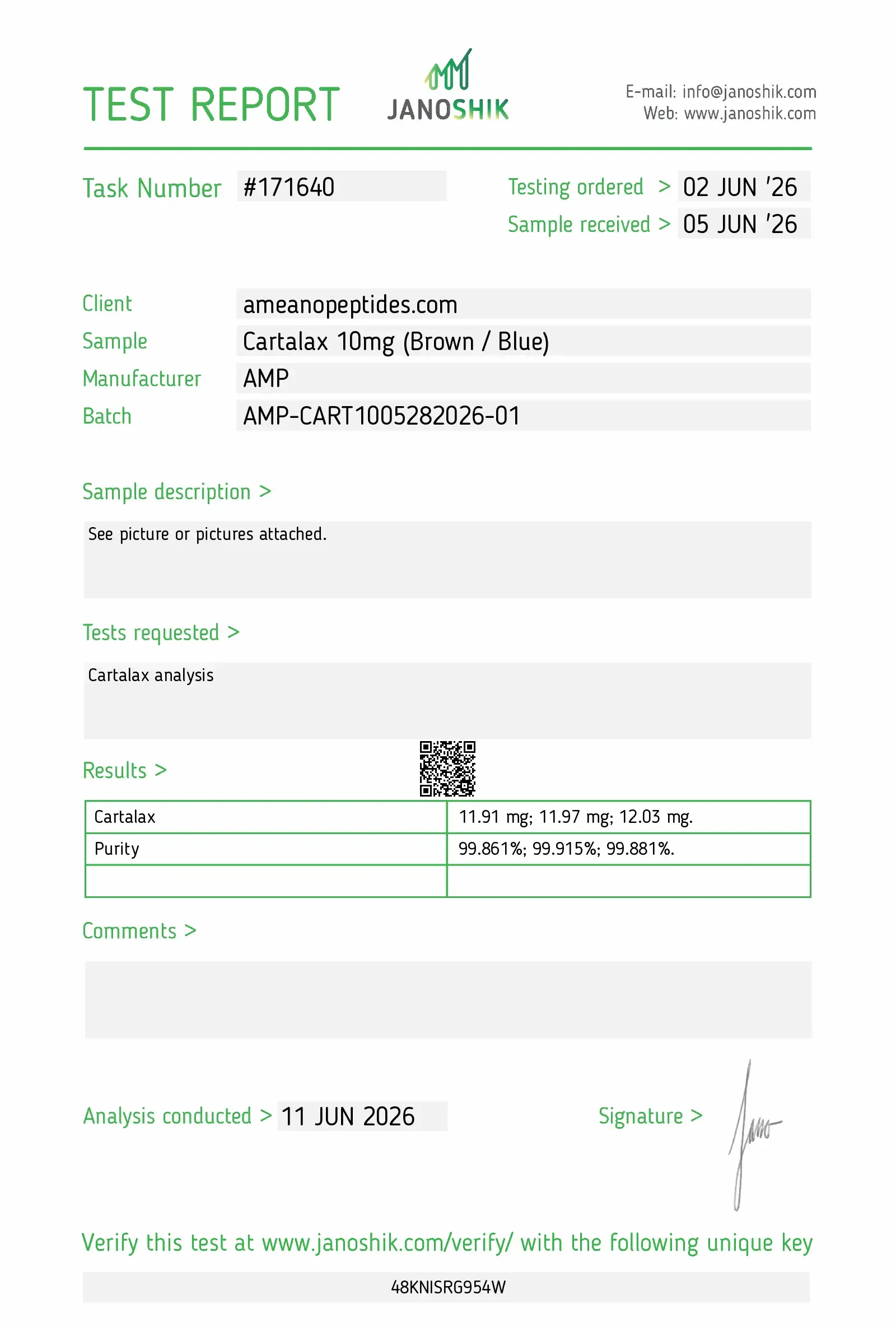
Cartalax COA lab report showing 10 mg peptide purity around 99.9%

Janoshik Analytical test report for Ameano Peptides, task number 171640. Ameano Peptides backs its catalog with third-party laboratory testing and publishes the results openly. The public COA library on the AMP site lists roughly fifty products, and each one links to a lab report carrying a unique task number that can be checked against the testing laboratory's records. The reports we reviewed come from Janoshik Analytical, an independent third-party lab widely used across the research peptide market.


The testing shown covers two things: purity by high-performance liquid chromatography (HPLC) and identity confirmation by mass spectrometry. AMP states a 99 percent or higher purity standard across its products. The company also describes its own production steps: laboratory-grade purified water as the base, mannitol and sucrose as stabilizing excipients, electrospray ionization mass spectrometry (ESI-MS) to confirm molecular structure, a 0.22 micron filtration step, and a controlled 36-hour lyophilization cycle.


Two limits are worth stating plainly, because they are why this review sits at 3.2 rather than higher. First, the COAs show purity and quantification, but they do not show per-lot endotoxin or sterility testing, which is the documentation researchers most want for injectable-format material. Second, the testing runs through a single laboratory that is not ISO/IEC 17025 accredited, and the library reads as a per-product snapshot rather than a rolling per-batch record with a consistency history. None of that contradicts the purity data on file. It simply means the depth of accreditation and lot-level safety testing has room to grow.


Any compound's COA can be verified directly in the AMP COA library before ordering.

Ameano Peptides September 2026 Review Summary

Our editorial rating for Ameano Peptides is 3.2 out of 5, a Standards Score of 45 out of 100. The score reflects genuinely open purity documentation held back by a single non-accredited laboratory, no published endotoxin or sterility data, and a young operating history.

Headline strengths:

  • Public, task-numbered third-party COA library spanning roughly fifty products.
  • Stated 99 percent or higher purity, with HPLC and mass spectrometry data shown.
  • A named United States legal entity with a verifiable address, phone, and email.
  • A broad catalog with deep GLP-1 research coverage and a documented in-house production process.
  • Same-day or 24-hour dispatch on qualifying orders, with discreet packaging.


Where it loses ground:

  • No per-lot endotoxin or sterility testing shown.
  • A single, non-accredited testing laboratory.
  • A short operating track record, so fulfillment reliability is not yet proven over time.


All AMP products are sold strictly for laboratory research use. Nothing on this page is medical advice, and none of these compounds are intended for human or animal use.

Pros and Cons

Pros

  • Transparent, browsable COA library with verifiable lab task numbers.
  • Strong, well-documented GLP-1 research line.
  • US-based LLC with public contact details.
  • Free shipping over $200 and fast dispatch.


Cons

  • No endotoxin or sterility data on the published COAs.
  • Single non-accredited lab; per-SKU rather than rolling per-batch documentation.
  • All sales final outside a narrow damaged-or-incorrect window.
  • New vendor with limited operational history.

What Does Ameano Peptides Sell?

AMP organizes its catalog into research peptides, research formulations (a cosmetic and topical line), and accessories. The depth is in the metabolic and GLP-1 category, but the recovery, cognitive, and longevity shelves are well stocked too.


GLP-1 and Metabolic Research

This is AMP's center of gravity. The proprietary AMP-1P, AMP-2P, and AMP-3P lines are sold across multiple strengths (for example AMP-2P at 10, 15, 20, 30, and 60 mg, and AMP-3P from 6 mg up to 48 mg). The category also includes Cagrilintide, a Reta/Cagri blend, Survodutide, AOD-9604, and 5-Amino-1MQ. The research behind this compound class is covered in the tirzepatide guide.


Repair and Recovery

BPC-157, TB-500 (Thymosin Beta-4), the TB-500 Fragment 17-23, KPV, PDA, and proprietary recovery blends such as the Glow and Klow blends. The safety evidence on BPC-157 is reviewed separately.


Growth Hormone Secretagogues

Ipamorelin, CJC-1295 (No DAC), Tesamorelin, Sermorelin, and several pre-mixed blends.


Cognitive Research

Semax, Selank, and a Semax/Selank blend.


Longevity and Cellular

Epitalon, MOTS-c, NAD+ (buffered), Thymosin Alpha-1, and GHK-Cu at research scale.


Research Formulations and Accessories

A cosmetic and topical line (GHK-Cu and AHK-Cu ampules, peptide creams and serums, microneedle products) plus accessories such as a vial opener and a 3D-printed vial storage case.


For background on how these compounds are studied, see the
Inside Project Biohacking Blog.

How AMP Material Arrives

AMP peptides ship as lyophilized powder. Storage requirements change once a vial is reconstituted, which is worth confirming against the product listing before ordering.


What a credible certificate should name, and what a purity figure alone leaves out, is covered in our
guide to third-party testing.

Research-only safety reminder: All Ameano Peptides products are sold for laboratory and research purposes only. Nothing on this page is intended for self-administration. Consult a qualified healthcare provider before applying any peptide research to a clinical decision.

What the returns position means before you order

AMP treats all sales as final, and the only exception is a product that arrives damaged or is not what you ordered. The reporting window is short and the evidence requirement is specific, so photograph the parcel and the vials before opening anything and check the order against your confirmation the day it lands. Waiting a week to open a box forfeits the only exception the policy offers.


Shipping rates, dispatch times and the full returns process are listed alongside Ameano's current code.


How Ameano Peptides Fits a Research Sourcing Strategy

For a metabolic or GLP-1 research program, AMP's combination of a deep GLP-1 line and openly published COAs makes it straightforward to verify identity and purity before committing to a study.


The scores in our rating methodology put AMP alongside the other reviewed sources. The missing endotoxin and sterility data is the item to confirm directly with the vendor for any sterile-format research.


The Ameano Peptides catalog is limited to laboratory research use, and none of its compounds carry approval for human or veterinary use.

Ameano Peptides FAQ

  • Is Ameano Peptides legit?

    Ameano Peptides is a registered United States company, Ameano Peptides LLC, based in Little Rock, Arkansas, with a public address, phone number, and email. It backs its catalog with third-party laboratory testing and publishes a browsable COA library covering roughly fifty products, each tied to a verifiable lab task number. The reports show HPLC purity and mass spectrometry identity at a stated 99 percent or higher purity. The main limitation is that the COAs do not include endotoxin or sterility testing and run through a single non-accredited lab, which is why our editorial rating is 3.2 rather than higher.


  • Where does Ameano Peptides ship from?

    Ameano Peptides ships from the United States, with operations based in Little Rock, Arkansas. Orders go out via UPS, with same-day or 24-hour dispatch on qualifying orders and discreet, unmarked packaging. Shipping is free on orders over $200. International availability and customs handling depend on the destination, so confirm with the vendor before ordering outside the United States.


  • Are Ameano Peptides products for human use?

    No. All Ameano Peptides products are sold strictly for laboratory research use only and are not intended for human or veterinary consumption. The company makes no therapeutic claims, and none of its products have been evaluated by the FDA to diagnose, treat, cure, or prevent any condition. Peptides intended for human use are available by prescription through a licensed clinician; speak with a qualified healthcare provider.


  • Does Ameano Peptides provide Certificates of Analysis?

    Yes. Ameano Peptides publishes a public COA library on its site covering roughly fifty products. Each entry links to a third-party laboratory report identified by a unique task number, so the purity and identity data can be checked independently. The reports show HPLC purity and mass spectrometry identity confirmation. Note that the published COAs cover purity and quantification but do not currently include endotoxin or sterility results.


  • What is the Ameano Peptides return policy?

    Ameano Peptides treats all sales as final because of the nature of research chemicals. The only exceptions are items that arrive damaged or are different from what was ordered. To qualify, you must report the problem within 24 to 48 hours of delivery with photo and video evidence, the item must be unopened and unused, and the return must be started within 7 working days. Approved refunds are processed within 7 to 10 working days.


 Affiliate Disclosure: Some links on this page are affiliate links. If you make a purchase through them, Project Biohacking may earn a commission at no extra cost to you. This helps support our free research tools, educational content, and vendor reviews. We only recommend vendors we believe meet reasonable quality and transparency standards. This page is for educational purposes only, not medical advice. Nothing on this page is medical advice, a dosing recommendation, or guidance for personal use. Peptides intended for human use are available by prescription through a licensed clinician; speak with a qualified healthcare provider. Terms of Use & Disclaimer · Privacy Policy