Apollo Peptide Sciences Coupon Code PROBIO15: Is It Legit? (2026)

An honest look at Apollo's third-party testing, GLP-1 and incretin lineup, pricing, and the brand-name confusion with the defunct Peptide Sciences.


3.0 / 5 — Project Biohacking Editorial Rating

Apollo Peptide Sciences at a glance

Rating: 3.0 / 5 Best for: verified-purity GLP-1 sourcing from a newer, specialist vendor. Specialty: GLP-1 and incretin research peptides, including semaglutide, tirzepatide, and retatrutide. Testing: Janoshik third-party HPLC on every batch, with 99%+ purity on recent lots. Coupon: PROBIO15 for 15% off. Status: research-use-only. Not a compounding pharmacy. The catch: testing covers purity only, and the brand has little independent track record so far.

Affiliate disclosure: Some links on this page are affiliate links, meaning Project Biohacking may earn a commission if you purchase through them at no extra cost to you.

Who Apollo Peptide Sciences is, and who it is not

The first thing to settle is the name, because it confuses a lot of buyers. Apollo Peptide Sciences is not the original "Peptide Sciences." It is a separate, newer vendor that emerged after the original company shut down, and it has captured much of that defunct brand's search traffic rather than continuing the original business. If you searched "peptide sciences tirzepatide" and landed on Apollo, that is why.


We are not going to re-tell the closure story here. If you want the background on why the original vendor disappeared and what it meant for the grey market, read our breakdown of the Peptide Sciences shutdown. The short version for this page: treat Apollo as a vetted alternative for people who came looking for the old name, not as a revival of it.

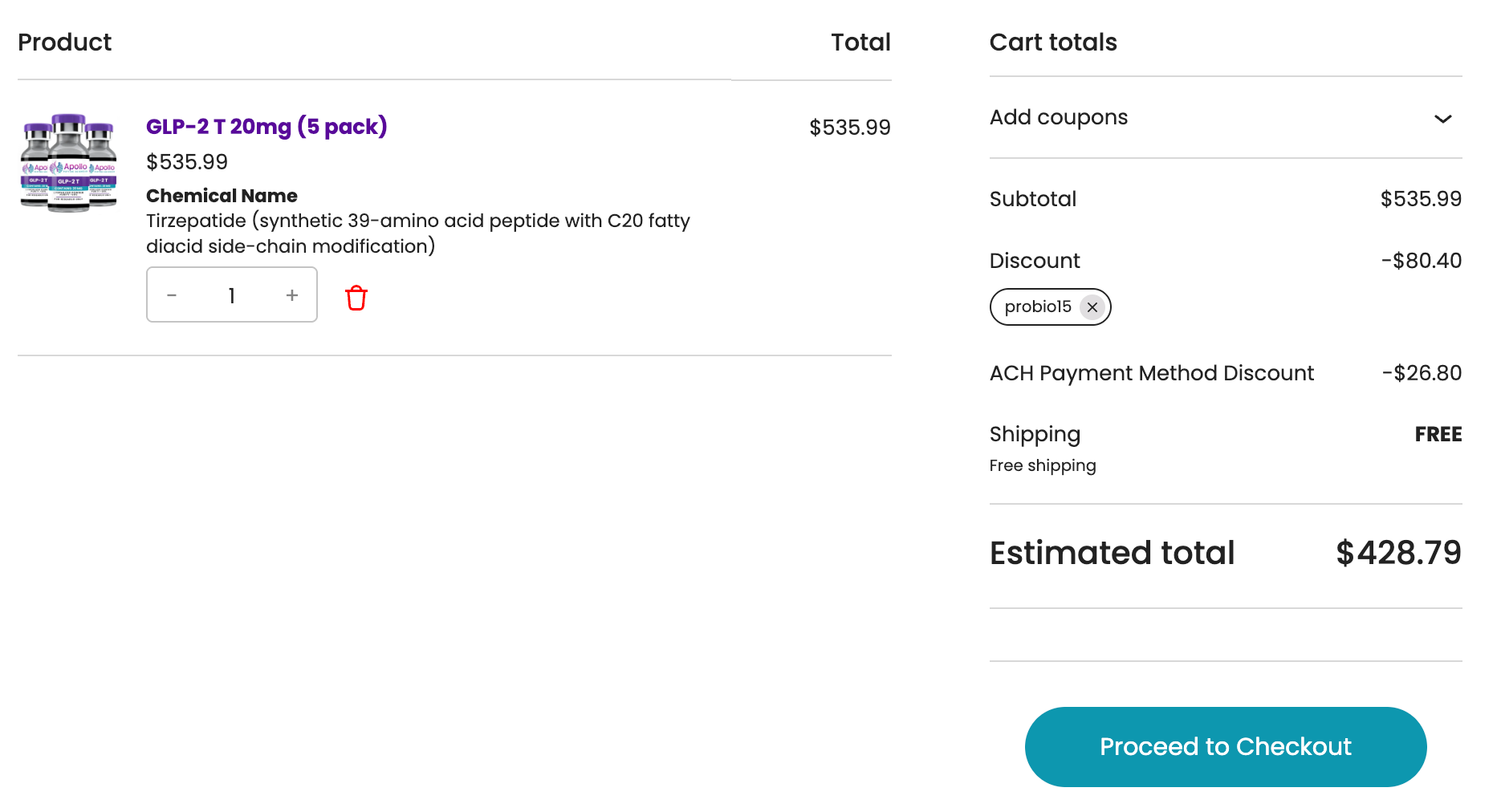
Apollo Peptide Sciences Discount and Coupon Code PROBIO15

The working code is PROBIO15, which takes 15% off. Coupon aggregators float a range of Apollo codes between 10% and 20%, and some are expired or worse, use PROBIO15 rather than chasing a higher number that may not apply at checkout.


Disclosure: Apollo is an affiliate partner, and Project Biohacking earns a commission if you buy through our link or use the code. That partnership does not change the 3.0 rating or the limitations below. The testing scope and the track-record gaps are reported the same way regardless of the relationship.

Apollo Peptide Sciences logo in purple and teal with a helix icon and text

The GLP-1 and incretin lineup

This is the core of Apollo's catalog and the reason most people find it. The lineup centers on the incretin family, the gut-signaling compounds that have driven the recent wave of metabolic research peptides. Apollo carries semaglutide under its in-house "GLP-1S" label, tirzepatide as "GLP-2T," and retatrutide as "GLP-3R." The naming convention is proprietary to Apollo, so do not read those codes as standardized industry terms.


We do not cover how these compounds work, what they do in the body, or any weight-related outcome on this page, because that is education, not sourcing. For the science, see our guide to GLP-1 agonists like semaglutide and tirzepatide and the separate look at GLP-1 safety considerations around gallbladder and pancreatitis risk.


What we can point to is a concrete proof point. Apollo's published testing on a recent tirzepatide lot (batch P525111L, April 2026) returned a purity result of 99.859%. A single batch is not a guarantee of every future vial, but a near-99.9% result on a flagship compound is a strong data point for an emerging vendor.

Quality and third-party testing

Janoshik COA for Apollo Peptide Sciences Tirzepatide 15mg showing 17.13mg content and 99.799% purity from blind GLP-1 testing.

Apollo runs third-party testing through Janoshik, an independent analytical lab widely used in the research peptide space. Every batch is tested by HPLC, which is high-performance liquid chromatography, the standard method for measuring how much of a sample is the intended compound. Results carry a QR code and a verification key, and recent lots clear a baseline of 98% or higher, frequently landing at 99%+.


One detail worth crediting: the testing is blind. The manufacturer is submitted to the lab as "Unknown," which removes a path for the lab to bias a result toward a known client. Apollo also reported generous fill on at least one product, with 25.48 mg measured in a vial labeled 20 mg, an overfill of about 127%.


Now the honest scope, because this is where a lot of vendors get a free pass they should not. Apollo's documented testing covers purity only. There is no published sterility, endotoxin, microbial, or mass-spectrometry panel, and public batch-level access to the full certificate of analysis is unconfirmed. Purity tells you what fraction of the powder is the right molecule. It does not tell you whether the material is sterile or free of bacterial byproducts. Before you trust any supplier's numbers, it helps to understand what third-party testing actually covers and what to look for in a COA.

The rest of the catalog

Beyond GLP-1s, Apollo stocks a standard research catalog rather than a deep specialty shelf. Recovery staples like BPC-157 and TB-500 are there, alongside GHK-Cu, NAD+ at 500 mg, CJC-1295 with Ipamorelin, SNAP-8, IGF-1 LR3, and Epithalon. There is no bioregulator depth and there are no proprietary blends. If your interest is one of these compounds rather than a GLP-1, Apollo is a reasonable stocking option, but it is not where the vendor differentiates itself.

Research-only positioning and compliance

Apollo labels and sells everything as research-use-only material. It provides no dosing or administration guidance, and it is not a 503A or 503B compounding pharmacy. That distinction matters for both legality and accountability. If you are unclear on the line, read what the research-only label actually means and how that differs from compounding-pharmacy peptides, which operate under a separate regulatory framework.


Handling, reconstitution, and storage

Apollo ships lyophilized vials, meaning the peptide arrives freeze-dried as a powder. You reconstitute it with bacteriostatic water, then keep it cold and dry, with a typical use window of four to six weeks when stored at 36 to 46°F. Getting the reconstitution math right is where most errors creep in, so run your vial through our free Peptide Calculator for exact figures before you mix. →

Apollo Peptide Sciences Shipping & delivery policy

Apollo’s shipping setup is designed to be predictable for U.S.‑based research orders:

  • Flat U.S. shipping rate: Most domestic orders ship for a flat 9.99 USD using Apollo’s standard shipping option.
  • Free shipping threshold: Apollo offers free shipping on orders over 200 USD, a policy reiterated in their site footer and quick‑links sections.
  • Processing time: According to their shipping page, orders are typically prepared within 24 hours of cleared payment and packed and shipped six days a week (Monday through Saturday), with a 2 p.m. Eastern cutoff for same‑day processing; orders placed after that time ship on the next available shipping day.
  • Carrier and transit speed: Marketing copy highlights “Fast Shipping,” with most orders leaving within about 48 hours via USPS Priority or Express services, and policy pages suggest a typical turnaround of approximately 3–4 business days from payment confirmation to delivery for standard U.S. shipments.
  • Returns and sensitivity: Because peptides are temperature‑ and handling‑sensitive, Apollo’s terms emphasize that returns are limited and that customers should verify address details and availability to receive shipments promptly.


For researchers, this means Apollo is best suited to planned GLP‑1 and peptide projects where a 3–4 business day delivery window and a 200 USD free‑shipping threshold fit into your sourcing strategy, rather than last‑minute or highly time‑sensitive runs.

Apollos Limitations and what to verify

A fair review names the weak spots plainly, and Apollo has several.


Testing is purity-only. Strong HPLC numbers, but no published sterility, endotoxin, or microbial data. Little independent validation. There is no meaningful Reddit, Trustpilot, or Finnrick history yet to corroborate the brand's own claims. New and low-traffic. Apollo is an emerging vendor, so longevity, consistency, and customer-service patterns are still unproven. Heavy aggregator footprint. The brand shows up across coupon sites, which inflates visibility without adding trust signals. Name confusion. The overlap with the defunct Peptide Sciences brand can mislead buyers who assume continuity that does not exist.


None of these is automatically disqualifying. Together they explain why Apollo earns a solid-but-cautious score rather than a top one.


Verdict

Apollo Peptide Sciences earns 3.0 / 5. Best for verified-purity GLP-1 sourcing from an emerging vendor, with the honest caveat that testing is purity-only and the track record is still thin. If those gaps are acceptable for your purposes, the purity data is among the better signals in this category.


See current pricing and apply PROBIO15 for 15% off → Visit Apollo Peptide Sciences


Apollo is one option among several vetted suppliers, so it is worth comparing its purity-only testing against vendors that publish broader panels before you commit. See how it stacks up in our full Vendor Directory.

Apollo Peptide Sciences FAQ

  • Is Apollo Peptide Sciences the same as Peptide Sciences?

    No. Apollo is a separate, newer vendor that rose after the original Peptide Sciences closed and absorbed much of its search traffic. It is not a continuation of the original company.


  • Is Apollo Peptide Sciences third-party tested?

    Yes. Apollo uses Janoshik for blind HPLC purity testing on every batch, with QR-coded results and recent lots at 99%+. The testing covers purity only, not sterility or endotoxins.


  • Does Apollo Peptide Sciences sell tirzepatide, semaglutide, and retatrutide?

    Yes. All three are in the lineup under Apollo's in-house labels, sold strictly as research-only material.


  • Is Apollo Peptide Sciences legit?

    The available evidence is positive on purity and transparent on testing, but the brand is new with little independent community history. It looks legitimate for verified-purity sourcing, with the caveat that its track record is still short.


  • What is the Apollo Peptide Sciences coupon code?

    PROBIO15 takes 15% off.


  • Are there Apollo Peptide Sciences reviews on Reddit?

    Independent community feedback is thin so far. Apollo has little established history on Reddit, Trustpilot, or Finnrick, so most available signal comes from its own published testing rather than third-party user reports.

  • Is Apollo Peptide Sciences a compounding pharmacy?

    No. Apollo sells strictly research-use-only material and is not a 503A or 503B compounding pharmacy, so it provides no dosing or administration guidance.

  • How should you store Apollo peptides after reconstitution?

    Apollo ships lyophilized (freeze-dried) vials that you reconstitute with bacteriostatic water, then keep cold and dry, with a typical use window of four to six weeks when stored at 36 to 46°F.

 Affiliate Disclosure: Some links on this page are affiliate links. If you make a purchase through them, Project Biohacking may earn a commission at no extra cost to you. This helps support our free research tools, educational content, and vendor reviews. We only recommend vendors we believe meet reasonable quality and transparency standards. This page is for educational purposes only — not medical advice. Please consult a qualified healthcare provider before starting any peptide or supplement protocol. Terms of Use & Disclaimer · Privacy Policy