
Ameano Peptides Discount Code PROBIO: 10% Off at AMP, October 2026
What Ameano sells is research material, not a consumer health product, and it carries no approval for human, veterinary, or diagnostic use.
Ameano Peptides, which also trades as AMP, cut a monthly test cart by 10 percent when PROBIO went in at ameanopeptides.com on the first day of October 2026.
Ameano Peptides Coupon Code PROBIO, 10% Off at AMP
10% Off
Ameano Peptides Discount Code
Checked at Ameano's checkout, October 2026
The Shop Ameano Peptides button opens the store through Project Biohacking's partner link. If PROBIO is not already in the cart, type it into the discount box for 10 percent off.
Whether a label says AMP or Ameano Peptides, it is one business with one code. PROBIO is the Ameano Peptides promotional code, not a storewide sale. The offer is 10 percent off the cart subtotal at checkout. Project Biohacking verified that savings on October 1, 2026: a vial priced at $98.00 came back at $88.20. The same promotional discount is the only code this page lists.
Affiliate Disclosure:
Project Biohacking may earn a commission on purchases made through links on this page, at no extra cost to you.

How to use the Ameano Peptides Promo Code in Your Checkout Cart
Open the Ameano (AMP) Store
Start at ameanopeptides.com; the site and the vials carry both the Ameano and AMP names.
Fill Your Cart With Ameano Research Peptides
The catalog runs across GLP-1 and metabolic research, repair and recovery, growth hormone secretagogues, cognitive compounds, and longevity and cellular work.
Type PROBIO Into the Ameano Code Box
Open the shopping cart, expand Got a discount code?, type PROBIO and press Apply.
Confirm the 10% PROBIO Discount Is Applied
A PROBIO tag and a minus figure should appear under the subtotal. No tag usually means another code is already sitting in the box. That tag is the savings. If the offers line does not show a promotional reduction, do not assume the code applied. Clear the box and enter PROBIO again before checkout.
Ameano Peptides Discount Code PROBIO at Checkout (October 1, 2026)
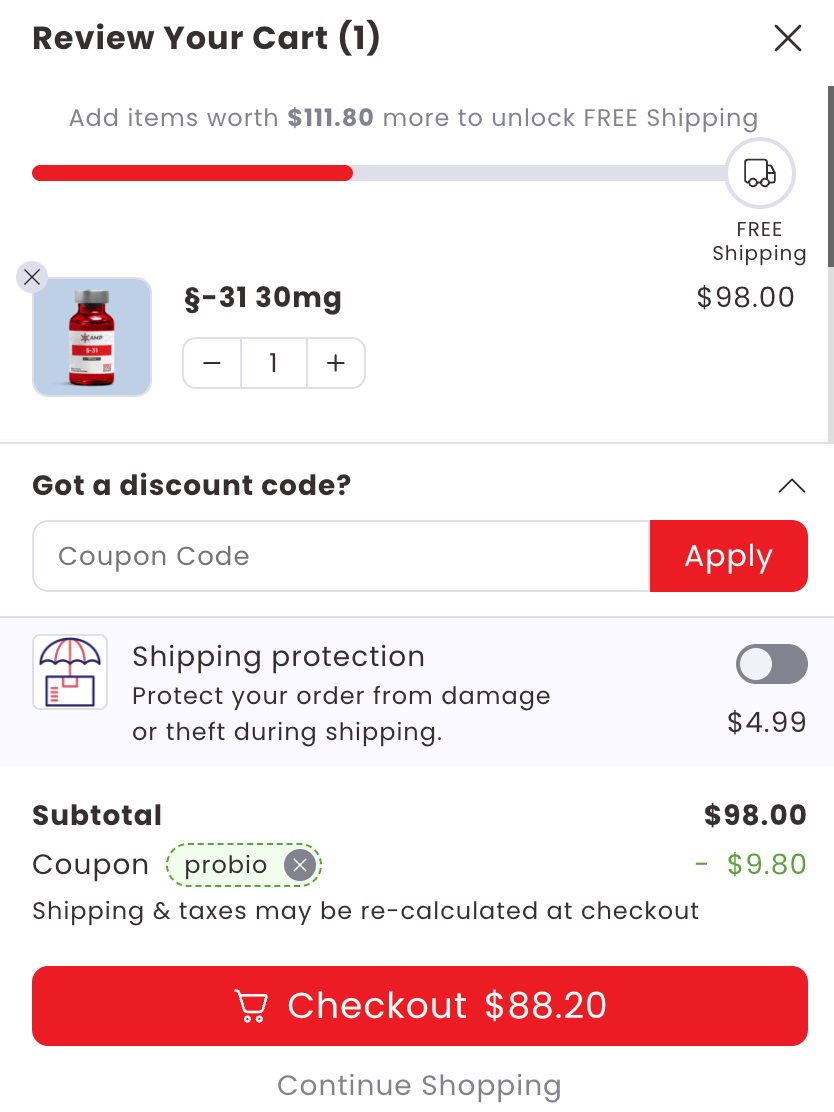
A single SS-31 30mg vial priced at $98.00 went into Ameano's shopping cart for October. The code was put in the box under "Got a discount code?" With PROBIO entered, $9.80 came off; the cart total read $88.20, and its free-shipping bar asked for $111.80 more.
Can the Ameano Peptides Coupon Code Stack With Sale Codes?
Ameano's own sale codes can sit next to PROBIO. In a September 2026 cart, each discount came off the pre-discount subtotal, so a 30 percent sale code plus PROBIO took 40 percent off rather than 37. Ameano does not publish the stacking rule, so read the order total before paying. Those sale codes are Ameano's own promotional offers. They are separate from PROBIO, and they only stack when Ameano has one running. The October verification is the cart image above.
Ameano Pre-Sale Products
A Pre-Sale menu lists compounds before general release at pre-sale prices; on October 1, that included Eloralintide 10mg at $178, down from $228. Pre-sale pricing is separate from the code.
Ameano Peptides Discount Code and Free Shipping Over $200
Ameano counts the $200 after PROBIO. That October drawer proves it: $88.20 plus the $111.80 it asked for is exactly $200.
The drawer's progress bar updates as items go in, so add the code first and then read the gap.
Our Ameano Peptides review covers shipping rates, the returns rules, and how the certificates are tested.
AMP Peptides Discount Code: Verified Monthly by Project Biohacking
A Project Biohacking cart goes through Ameano's checkout with PROBIO every month, and the month on this page does not change until that cart's result is written down. October's ran on October 1, 2026.
If PROBIO stops working on one of those checks, we remove it from the page that day.
AMP's code is PROBIO at 10 percent; to compare it, open the peptide coupon code directory.
Ameano Peptides Promo Code FAQ
What is the Ameano Peptides discount code?
It is PROBIO, worth 10 percent, and it applies whether the store calls itself Ameano Peptides or AMP. The most recent cart test was on October 1, 2026.
How do I use PROBIO at Ameano Peptides?
Fill the cart at ameanopeptides.com, enter PROBIO under Got a discount code? in the shopping cart, and confirm the PROBIO tag shows before checkout.
Can you use more than one Ameano Peptides code at a time?
Yes, with Ameano's own sale codes. In a September 2026 cart each discount came off the pre-discount subtotal, so a 30 percent sale code plus PROBIO came to 40 percent off rather than 37. Free shipping is counted after the discounts, so stacking widens the gap to $200.
Does Ameano Peptides offer free shipping?
Yes, standard shipping is free over $200, counted after PROBIO is applied; the shopping cart shows the remaining gap as you add items.
Does the Ameano Peptides promo code expire?
It does not expire. A fresh cart test each month decides the date shown at the top.
How does Project Biohacking verify the Ameano Peptides coupon code?
One cart test at Ameano's checkout each month, code applied, outcome logged with its date.
Research compounds discussed here are for laboratory research only, not for human or veterinary use, and nothing on this page is medical advice.