
About the Author:
Jeff Nunn is the founder of Project Biohacking. With over 30 years of biohacking practice, he applies decades of self-experimentation methodology to peptide research, dosing math, and vendor evaluation.
Why storage affects confidence, not concentration
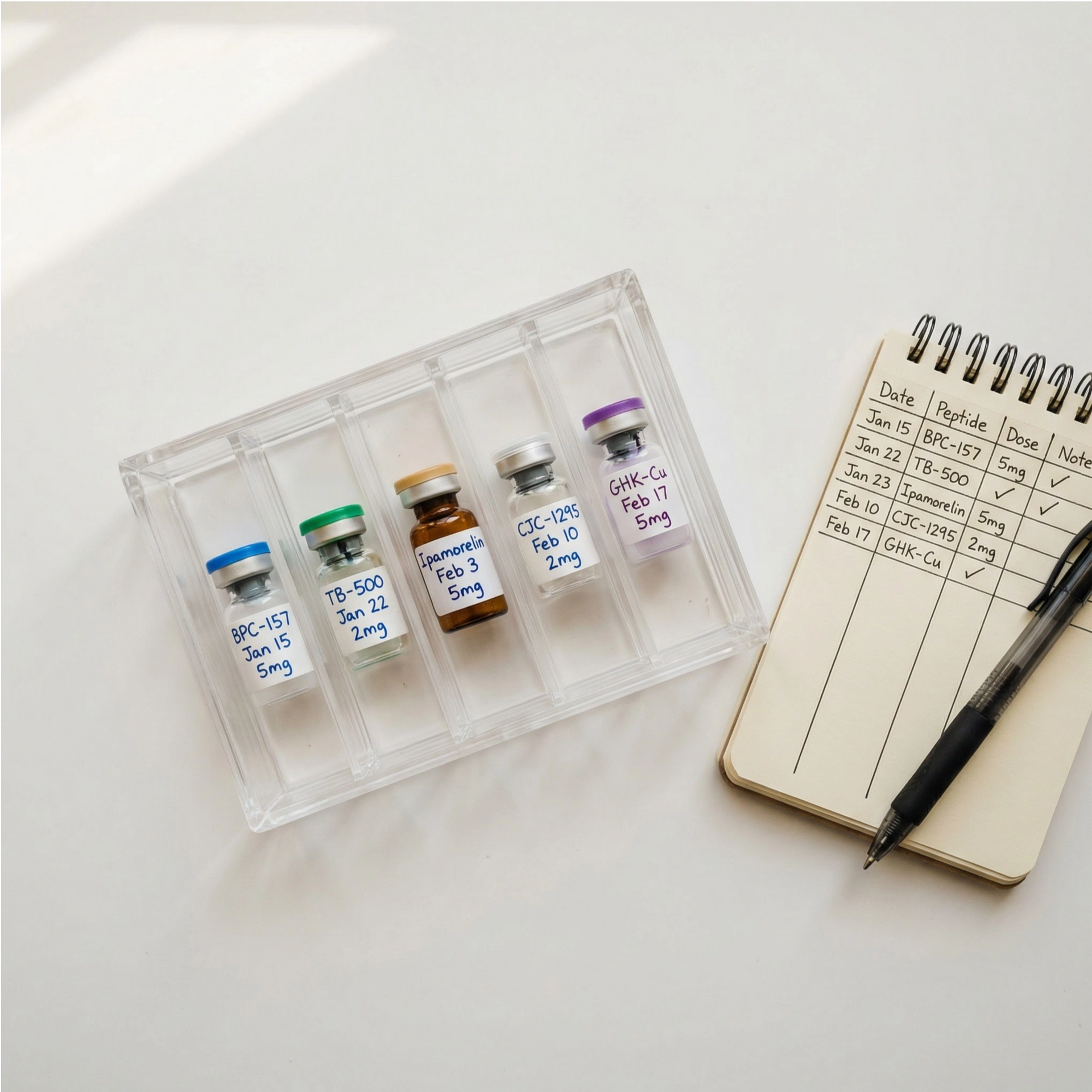
Peptide storage after reconstitution is a tracking problem disguised as a chemistry problem.
The concentration you calculated when you added bacteriostatic water doesn't change on its own. What changes is your ability to verify that the peptide inside still matches what the label says it contains. Storage conditions don't rewrite the math. If you reconstituted a 5mg vial with 2mL of water, the concentration remains 2.5mg/mL whether the vial sits in your refrigerator for three days or three weeks.
What you lose over time isn't the number. It's the confidence that the number still describes something pharmacologically identical to what you started with. This is why peptide storage after reconstitution centers on labeling, organization, and decision rules. You can't test potency at home. You can only create systems that reduce the uncertainty introduced by time, temperature variation, and repeated access.
Concentration is a ratio. It describes how much peptide mass exists per unit of solvent.
That ratio doesn't change unless you add more solvent or allow evaporation. If you withdraw 0.1mL from a vial with a concentration of 2.5mg/mL, you've withdrawn 0.25mg of peptide. The remaining solution still has a concentration of 2.5mg/mL. This remains true regardless of storage duration.
A vial stored for one day and a vial stored for one month contain the same calculated concentration if both started with identical reconstitution parameters. The difference isn't in the math, as explained in our Peptide Dosage Math Explained guide. The difference is in the assumption that the peptide still functions as expected.
Peptide storage after reconstitution doesn't alter your dosage calculations. It alters the margin of error in those calculations. When you can't verify potency, time becomes a proxy for risk. The longer a vial sits, the more assumptions you're layering onto your original calculation.
You don't lose confidence in a vial because it looks different. You lose confidence because you can't remember when you reconstituted it, what concentration you used, or which peptide is actually inside.
Peptide storage after reconstitution requires external documentation because the solution itself offers no identifying information. A complete label includes peptide name, reconstitution date, final concentration, volume used for reconstitution, and a discard-by date based on whatever decision rule you've adopted. Without these data points, you're guessing.
You might remember that you reconstituted something two weeks ago, but you won't remember whether it was 2mL or 5mL unless you wrote it down.
This becomes critical when storing multiple peptides. Identical vials in identical storage conditions become interchangeable without labels. If you have three unlabeled vials in your refrigerator and you know one is BPC-157, one is TB-500, and one is GHK-Cu, you have a three-way guessing problem. If you guess wrong, your dosage calculation becomes irrelevant because you're injecting the wrong peptide entirely.
Labeling also prevents concentration errors. If you reconstitute the same peptide at different concentrations across multiple vials, forgetting which concentration applies to which vial turns every withdrawal into a potential overdose or underdose. The concentration printed on the original lyophilized vial doesn't apply after reconstitution. The concentration you calculate and write on the label is the only number that matters.
Peptide storage after reconstitution introduces variables you can control and variables you cannot.
You cannot stop time. You cannot eliminate all temperature fluctuation. You cannot test potency without lab equipment. What you can control is whether you know which vial you're using, when you reconstituted it, and what assumptions you're making about its current state.
A tracking system doesn't need to be complex. A notebook with reconstitution dates, peptide names, volumes, and expected discard dates is sufficient. Digital spreadsheets work if you prefer them. The format matters less than the consistency. If you track some vials and forget others, the system provides no protection.
Tracking also allows you to identify patterns. If you consistently discard vials before they're empty because they've exceeded your storage window, you can adjust reconstitution volume downward for future batches. If you're running out of a peptide before the next shipment arrives, tracking helps you identify whether the problem is dosing frequency or storage waste.
Without third-party testing, you can't distinguish between a vial that contains 100% active peptide and a vial that contains 70% active peptide, 20% degradation byproducts, and 10% something you can't identify.
Both look identical. Both have the same calculated concentration. The difference is invisible.
This is the core problem of peptide storage after reconstitution. Potency and concentration are not the same thing. Concentration measures mass per volume. Potency measures pharmacological activity. A peptide can maintain its molecular weight while losing its ability to bind to receptors, signal cellular responses, or produce the effects you're expecting.
Time increases the probability that these two numbers diverge. Temperature fluctuations, light exposure, and repeated access all contribute. Refrigeration slows the process. Careful handling reduces contamination risk. But neither eliminates the fact that you're operating on assumptions rather than measurements.
Peptide storage after reconstitution benefits from consistency.
If you store vials in the same location every time, you eliminate the variable of forgetting where you put them. If you store them in a drawer rather than on a shelf, you reduce light exposure. If you store them in a dedicated container, you reduce the chance of accidental disposal or handling by others.
Refrigerator placement affects temperature stability. The door shelves experience the most variation. The back of the middle shelf tends to be most stable. If you're storing peptides in a shared refrigerator, a labeled container prevents confusion and reduces the chance that someone else discards a vial assuming it's expired food.
Routine also reduces contamination opportunities. If you withdraw doses at the same time each day using the same preparation steps, you minimize the number of times the vial is accessed and reduce the cumulative contamination risk from repeated needle punctures. This doesn't eliminate risk, but it does create a predictable baseline.
The volume of bacteriostatic water you use during reconstitution determines both concentration and total storage duration.
Proper storage after reconstitution starts with using the right solvent. Bacteriostatic water contains 0.9% benzyl alcohol that inhibits bacterial growth, giving your reconstituted peptide solution a reliable window of stability when refrigerated. For a complete breakdown of the solvent itself, including composition, safety, and best practices, see our dedicated guide: Bacteriostatic Water: What It Is and How to Use It for Peptides.
A higher volume produces a lower concentration and a larger total volume to store. A lower volume produces a higher concentration and a smaller total volume. Both choices have storage implications.
If you reconstitute a 30-day supply at once, the last dose will be stored for nearly a month. If you reconstitute a 7-day supply, the maximum storage duration is one week.
Shorter storage windows reduce uncertainty at the cost of more frequent reconstitution. Longer storage windows reduce handling frequency at the cost of increased uncertainty about later doses. A peptide reconstitution guide helps you calculate volumes and concentrations, but it doesn't tell you how to balance storage duration against handling frequency. That decision depends on your confidence threshold and your willingness to discard partially used vials.
Cloudiness, discoloration, or visible particles indicate that something has changed.
They don't confirm degradation, and they don't confirm contamination, but they do confirm that the solution no longer matches its original state. When visual changes occur, the safest assumption is that the vial is no longer usable.
Most degradation and contamination events produce no visual changes. A peptide can lose significant potency while remaining perfectly clear. Bacterial contamination can reach unsafe levels without visible cloudiness. Visual inspection is a minimum threshold, not a comprehensive quality check.
This is why peptide storage after reconstitution relies on decision rules rather than observation. You can't see potency loss. You can't see early-stage contamination. You can only establish rules about how long you're willing to use a vial under specific conditions and then follow those rules consistently.
If you're uncertain whether a peptide has degraded, you're uncertain whether your dose is accurate.
A 0.25mg dose of a fully potent peptide produces different effects than a 0.25mg dose of a partially degraded peptide. The volume you're injecting remains the same always follow proper sterile technique , see where to inject peptides and injection sites for a full checklist. The pharmacological effect does not.
This uncertainty compounds over time. The first dose from a freshly reconstituted vial carries minimal storage-related uncertainty. The last dose from a vial stored for weeks carries maximum uncertainty. If you're using that peptide for something where consistency matters, the storage variable introduces noise you can't account for.
Some people accept this uncertainty and adjust based on subjective response. Others prefer to discard vials before uncertainty becomes significant. Neither approach is objectively correct. Both require you to acknowledge that peptide storage after reconstitution changes the reliability of your assumptions, not the numbers you're using to calculate doses.
Peptide storage after reconstitution forces you to make decisions without complete information.
You don't know the exact degradation rate for the specific peptide you're using. You don't know whether the temperature in your refrigerator fluctuated while you were asleep. You don't know whether the vial was contaminated during the last withdrawal.
What you do know is that risk increases with time, temperature variation, and repeated access. You can reduce those variables by refrigerating immediately, minimizing access frequency, and using vials within a conservative window. You can track reconstitution dates to avoid using vials past your chosen threshold. You can label vials to prevent mix-ups that would make all your calculations irrelevant.
None of these steps eliminate uncertainty. They reduce it to a level where you can make informed decisions about what assumptions you're willing to accept.
That's the practical reality of peptide storage after reconstitution. You're not managing chemistry. You're managing confidence in the absence of lab verification.
Temperature control slows degradation. Organization prevents errors that make degradation irrelevant.
If you inject the wrong peptide because you grabbed an unlabeled vial, it doesn't matter whether that vial was stored perfectly. If you miscalculate a dose because you forgot which concentration you used, refrigeration didn't solve the problem.
Peptide storage after reconstitution requires both. You need conditions that slow degradation and you need systems that prevent identification and calculation errors. A perfectly refrigerated, unlabeled vial is still a guessing game. A perfectly labeled vial stored at room temperature has a short usable window. Both variables matter.
The simplest organizational system is one you'll actually use. If detailed tracking feels burdensome, you won't maintain it. If labeling feels tedious, you'll skip it.
The goal isn't perfection. The goal is consistency good enough to prevent the most common errors: using the wrong peptide, using the wrong concentration, or using a vial stored beyond your comfort threshold.
When you use a peptide that's been stored longer than you intended, under conditions you're unsure about, or without clear labeling, you introduce variables you can't account for.
The dose you calculate may not match the dose you receive. The effect you expect may not match the effect you observe.
This isn't catastrophic in most cases. It's noise. It's a variable that makes it harder to assess whether a peptide is working as expected. If you're using peptides for cognitive enhancement, recovery, or longevity, inconsistent storage introduces inconsistency in results. You can't distinguish between a peptide that doesn't work and a peptide that degraded before you used it.
Peptide storage after reconstitution matters because it determines how much of that noise you're willing to tolerate. Conservative storage practices reduce noise. Lax storage practices increase it. Neither eliminates uncertainty entirely, but one produces more predictable results than the other.
Peptide storage after reconstitution is one step in a sequence.
You source a peptide, verify its documentation, reconstitute it, calculate doses, store it, withdraw it, and use it. Every step introduces variables. Storage is where time becomes unavoidable.
You can optimize reconstitution technique. You can double-check peptide dosage calculation. You can standardize withdrawal procedures.
You can't eliminate time.
What you can do is create systems that acknowledge time as a variable and manage it with labeling, tracking, and decision rules. That's the functional goal of peptide storage after reconstitution. Not perfect preservation. Not zero degradation. Just enough structure to know what you're using, when you reconstituted it, and what assumptions you're making about its current state.
Purchase peptides from vendors that provide clear COAs and third-party testing. What each panel actually covers is set out in the Biolongevity Labs review and the Limitless Biotech review.
Both Biolongevity Labs and Limitless Biotech use the same Project Biohacking code, PROBIO15, for 15 percent off at checkout. Current codes for every supplier Project Biohacking works with are collected on the
peptide coupon codes page.
No. Concentration remains constant unless you add more solvent or allow evaporation. What changes is your confidence that the peptide maintains its original potency and identity over time.
Labels prevent mix-ups between identical-looking vials and ensure accurate dosing by documenting peptide name, concentration, reconstitution date, and volume used. Without labels, you're guessing.
Include peptide name, reconstitution date, final concentration, volume of bacteriostatic water used, and your chosen discard-by date. This prevents identification errors and supports accurate dose calculations.
Most degradation produces no visible changes. Cloudiness or discoloration indicates something changed, but clear solutions can still have reduced potency or contamination you cannot see.
Storage duration increases uncertainty about potency and contamination risk. Conservative storage windows reduce this uncertainty, while extended storage increases assumptions you cannot verify without testing.
Tracking dates allows you to make informed decisions about when to discard vials based on your risk tolerance and prevents using peptides stored beyond your chosen threshold without realizing it.
Tracking reconstitution dates is one of the simplest ways to protect potency and avoid using a solution past your personal risk threshold. Once you have the math and volume correct, the most practical way to verify your calculations and convert concentration into precise syringe units is with a dedicated Peptide Calculator: Reconstitution & Dosage Tool. It handles mg-to-mcg conversions, dilution volumes, and IU outputs instantly so you can focus on safe storage and consistent protocols.

About the Author:
Jeff Nunn is the founder of Project Biohacking. With over 30 years of biohacking practice, he applies decades of self-experimentation methodology to peptide research, dosing math, and vendor evaluation.
Important Disclaimer: The content on Project Biohacking is for educational and informational purposes only and is not intended as medical advice, diagnosis, or treatment. Always consult a qualified healthcare professional before making any changes to your health regimen, starting new supplements, peptides, or protocols. Nothing on this site establishes a doctor–patient relationship, and you use the information at your own risk. Research compounds discussed here are sold for laboratory research purposes only and are not approved for human or veterinary use or consumption.
“For educational use only. Not medical advice. Read our full disclaimer.”
+1 214-278-4039
All Rights Reserved | Project Biohacking