
About the Author:
Jeff Nunn is the founder of Project Biohacking. With over 30 years of biohacking practice, he applies decades of self-experimentation methodology to peptide research, dosing math, and vendor evaluation.
Why most dosing mistakes happen before a calculator is ever opened
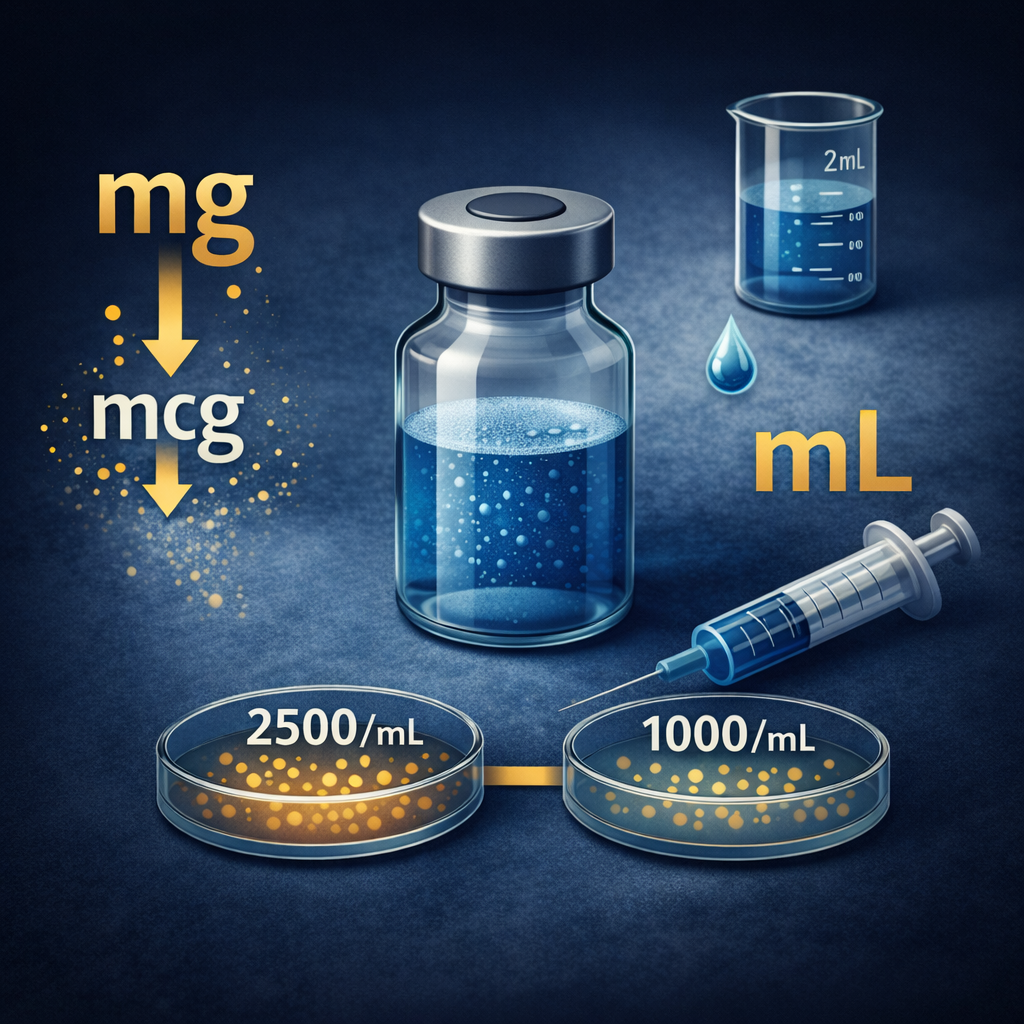
Peptide dosing feels confusing for many people, even those who have been around peptides for years. The confusion rarely comes from the peptide itself. It usually shows up much earlier, at the point where numbers are assumed instead of calculated.
Most dosing mistakes are quiet. They do not announce themselves as errors. Because a single decimal error multiplies the dose, it is worth understanding whether you can overdose on peptides and what the safety data actually shows. They look like reasonable guesses that happen to be wrong. When that happens, the calculator gets blamed, the protocol gets questioned, or the peptide gets written off.
Peptide dosage calculation brings order to that chaos. Once the math is understood, dosing stops feeling like guesswork and starts feeling consistent.
Every peptide dose is governed by the same four inputs. Nothing more is required, and nothing less will work.
• The mass of peptide in the vial, usually labeled in milligrams
• The volume of liquid added during reconstitution, measured in milliliters
• The resulting concentration, expressed as micrograms per milliliter
• The target dose, typically discussed in micrograms
When even one of these values is assumed rather than calculated, the result becomes unreliable. This is why it is important to work through them in order. The math comes first. The calculator comes second. Once the inputs make sense, the peptide calculator can be used to verify the result.
Milligrams and micrograms are separated by a factor of one thousand. On paper, that seems obvious. In practice, it is one of the most common sources of dosing error.
Peptide vials are almost always labeled in milligrams. Individual doses are almost always discussed in micrograms. When that conversion step is rushed or skipped, the math fails immediately.
This is also where frustration with calculators begins. The calculator is not guessing. It is following instructions. If the unit conversion is wrong, the output will be wrong. Used correctly, the peptide calculator confirms conversions rather than compensating for them.
Once you understand the math behind concentration, use our peptide calculator for injection to instantly convert your target dose into the correct draw volume from any reconstituted vial.
Concentration is not an inherent property of a peptide. It is established during reconstitution. f you have noticed different calculators giving different results for the same inputs, our guide to why peptide calculators differ explains exactly why that happens.
Two vials containing the same amount of peptide can end up with very different concentrations depending on how much liquid is added. More liquid lowers the concentration per milliliter. Less liquid raises it. The peptide itself remains unchanged.
This is why copying dosing charts without recalculating concentration leads to inconsistent results. Charts assume a concentration that may not match the one created during reconstitution.
For a practical explanation of how dilution volume determines concentration, the peptide reconstitution guide walks through that relationship clearly.
Take a vial containing 5 mg of peptide.
If 2 mL of liquid is added, the concentration becomes 2,500 micrograms per milliliter.
If 5 mL of liquid is added instead, the concentration becomes 1,000 micrograms per milliliter.
Nothing about the peptide changed. Only the dilution volume did. That single decision alters how much peptide is delivered per milliliter and how volume maps to dose.
This is why recalculating matters every time dilution volume changes.
Most dosing errors follow the same patterns:
– Confusing milligrams with micrograms
– Treating concentration as fixed when it is not
– Copying charts without recalculating inputs
– Ignoring how dilution volume affects delivery
Static charts struggle because they rely on assumptions. Live peptide dosage calculation, based on real inputs, removes those assumptions. When the math is recalculated properly, outcomes become predictable. If you want to revisit the full workflow, the peptide dosage calculator tool remains the anchor reference.
A calculator works best when the person using it understands the inputs. It confirms the math rather than replacing it.
Once units, dilution volume, and concentration are clear, the peptide calculator becomes a fast way to double-check results. Used this way, it reinforces confidence instead of introducing doubt.
When it comes to measuring peptides, precision is non-negotiable. An insulin syringe is designed for meticulous dosing, typically marked in increments as small as 0.01 mL (1 IU). This allows users to prepare and administer peptide solutions with confidence, ensuring accuracy and safety.
Insulin syringes generally come in 1 mL (100 IU), 0.5 mL (50 IU), and 0.3 mL (30 IU) sizes. The fine measurements make them well-suited for drawing up exact peptide doses based on peptide calculator mg results. The needle gauge, often 29G to 31G, also minimizes discomfort. Different syringe sizes require proper interpretation of peptide calculator mg outputs. A reliable calculator converts milligrams into exact IU measurements, ensuring your selected syringe size matches your intended dose without guesswork.
To use an insulin syringe for peptides:
After drawing your dose, understanding peptide injection technique correctly is the next step in maintaining accuracy and consistency. Proper injection technique ensures the calculated dose is delivered as intended.
Pairing a reliable peptide calculator with an insulin syringe is the standard approach for anyone serious about dosing consistency in peptide research. Using an insulin syringe is only one part of the process. Following a structured peptide injection guide helps ensure that preparation, measurement, and administration all align for consistent research outcomes.
Water plays a crucial role in accurately calculating and reconstituting peptides. The type and amount of water used can have a significant impact on the final concentration and stability of your peptide solution.
When preparing peptides, always choose sterile, bacteriostatic, or distilled water. Avoid tap water and other unsterile options, as impurities can compromise your results and risk contamination. Choosing the right solvent is critical for stability and accuracy. Using bacteriostatic water guide for peptides helps reduce contamination risk and supports multi-use applications when handled correctly.
Precise measurement of water is essential. Use a calibrated pipette or syringe for exact volumes according to your calculator output. This ensures that your peptide is dissolved to the correct concentration, maximizing consistency in research applications.
Always store water in clean, sterile containers. If the reconstituted peptide solution will not be used immediately, refrigerate or freeze as recommended to maintain stability. Exposure to light and repeated freeze-thaw cycles can degrade peptides, so proper handling is essential. Once your peptide is properly mixed and stored, the final step is preparing for the injection. This ensures that your calculated concentration and measured dose translate into accurate administration.
Peptide dosage calculation is the process of determining the exact volume to draw from a reconstituted vial to deliver a specific dose. It requires knowing the total peptide mass in the vial, the volume of bacteriostatic water added during reconstitution, and the target dose in micrograms — then converting those three inputs into a precise milliliter draw volume using an insulin syringe.
Concentration per milliliter determines how much peptide is delivered in a given volume. It is set during reconstitution and changes when dilution volume changes, even if the peptide amount stays the same.
Milligrams and micrograms are units of mass, where one milligram equals one thousand micrograms. Peptide vials are usually labeled in milligrams, while doses are commonly discussed in micrograms, making conversion essential. For weight-based dosing in animals, use the peptide calculator for pets to convert microgram-based dosing into an accurate, measurable draw volume.
Peptide dosing charts assume a fixed concentration. If the actual concentration created during reconstitution is different, the chart no longer applies and the math must be recalculated.
A peptide calculator cannot replace understanding dosage math. It verifies calculations based on inputs provided, but incorrect assumptions about units or concentration will still produce incorrect results.
Peptide dosage should be recalculated whenever dilution volume changes, vial mass changes, or units are converted. Any change to these inputs alters concentration and dose math.
Important Disclaimer
The information provided on this page and throughout Project Biohacking is for educational and informational purposes only. It is not intended as medical advice, diagnosis, or treatment, and does not replace consultation with a qualified healthcare provider.
Peptide use, reconstitution, dosing, and injection techniques carry risks. All content assumes you have been properly trained and prescribed by a licensed clinician. Individual results vary. Never self-administer peptides without professional medical supervision.
Project Biohacking and its authors assume no responsibility or liability for any injury, loss, or damage resulting from the use or misuse of information on this site. Always follow your clinician’s instructions, verify all calculations independently, and seek immediate medical attention for any adverse reactions.
Statements regarding peptides have not been evaluated by the FDA. This site does not sell or dispense peptides and makes no claims about efficacy, safety, or therapeutic use.

About the Author:
Jeff Nunn is the founder of Project Biohacking. With over 30 years of biohacking practice, he applies decades of self-experimentation methodology to peptide research, dosing math, and vendor evaluation.
Important Disclaimer: The content on Project Biohacking is for educational and informational purposes only and is not intended as medical advice, diagnosis, or treatment. Always consult a qualified healthcare professional before making any changes to your health regimen, starting new supplements, peptides, or protocols. Nothing on this site establishes a doctor–patient relationship, and you use the information at your own risk. Research compounds discussed here are sold for laboratory research purposes only and are not approved for human or veterinary use or consumption.
“For educational use only. Not medical advice. Read our full disclaimer.”
+1 214-278-4039
All Rights Reserved | Project Biohacking