Peptidology Review: August 2026

Peptidology is a research peptide supplier operating from Scottsdale, Arizona. Project Biohacking scores it 76 out of 100, which is the highest score in our vendor directory.


This review covers what its certificates actually show, which laboratories issue them, and where the documentation is stronger than anything else we have audited.


Last updated: August 1, 2026


Peptidology
Project Biohacking Editorial Rating
4.8 / 5
76 Standards Score out of 100
Analytical documentation 50% of score
Ownership and accountability 20% of score
Commercial terms 20% of score
Independent record 10% of score
Scored by Jeff Nunn, Project Biohacking, August 2026. Every supplier in the directory is scored on these four weighted criteria. Read the rating methodology.

Peptidology publishes the deepest analytical documentation of any supplier we track. A seven-procedure release battery on every lot, a fourteen-procedure advanced tier on most of the catalogue, three independent ISO 17025 accredited laboratories, and sterility validated by two different methods.


The gap is ownership. No founder or principal is named anywhere on the site.

Affiliate disclosure: Some links on this page are affiliate links. If you purchase through them, Project Biohacking may earn a commission at no additional cost to you.

Peptidology logo with black text and a pink, teal, and orange wavy mark on a white background

Peptidology

Peptidology is part of the Project Biohacking verified peptide vendors directory, where suppliers are scored on documentation, ownership, commercial terms and independent record. This page covers what Peptidology's certificates actually show. The current code and how to use it are on the Peptidology coupon code page.

What Peptidology does well

  • Three ISO 17025 accredited laboratories, named on the certificates, with the A2LA certificate number printed on the document
  • A seven-procedure release battery on every lot, covering purity, quantity, identity, endotoxins, heavy metals and sterility, with a fourteen-procedure advanced tier adding residual solvents, TFA, conformity, solubility and container closure integrity on roughly two thirds of the catalogue.Sterility by two complementary methods, a compendial USP test and a rapid-detection method, with both required to pass before a lot ships.
  • A QR code on the vial that resolves to the certificate for that specific batch. Only one other supplier in our directory prints a scannable code, and it resolves to a product page rather than the batch document.
  • A per-lot quality scorecard showing how many vials were consumed in testing, how many laboratories were involved, and the result of every procedure.


Where it falls short


No ownership disclosure. No founder, principal or legal entity is named. A business address and phone number appear on the certificates rather than on the site.


Catalogue breadth. The range is narrower than suppliers who stock everything, which is a consequence of the documentation standard rather than a failing, but it means some compounds are not available.

Who it suits


Researchers who need analytical depth and are prepared to read a certificate. If your work is sensitive to endotoxin, residual solvents or counterion content, this is the only supplier in our directory that documents all three.


Buyers who want to know who owns the business will not find that here.

Third-party testing and laboratory documentation


Which laboratories test Peptidology products


Three appear in the certificate library, and all are ISO/IEC 17025:2017 accredited. Vanguard Laboratory and Eagle Analytical Services carry the routine release panel between them. TrustPointe Analytics appears on a single document.

Laboratories issuing Peptidology certificates, as published at peptidology.co/certificates/
Laboratory Accreditation Certificates published Role on the panel
Vanguard Laboratory ISO/IEC 17025:2017 204 Majority of the release panel, including compendial USP sterility
Eagle Analytical Services Inc. ISO/IEC 17025:2017 163 Second sterility method by ScanRDI rapid detection, plus release testing
TrustPointe Analytics LLC ISO/IEC 17025:2017 1 Single certificate in the library at time of review

Certificate counts read from the live library, which refreshes continuously. The library held 369 certificates across 70 compounds at the time of this review, with 41 further compounds in testing.

Accreditation with a checkable number is different from claiming third-party testing. The A2LA certificate reference on the document can be looked up independently, which is not true of most certificates in this market.

What a single lot actually gets tested for


We read the quality scorecard for CJC-1295 No DAC, lot 1684, released 1 June 2026.


25 vials consumed. 2 independent ISO 17025 laboratories. 11 analytical procedures.

CJC-1295 No DAC, lot 1684, released 1 June 2026. 25 vials consumed across two laboratories.
Procedure Method Result
Identity Mass confirmation Conforms
Purity HPLC Pass, within release specification
Assay and quantity Quantitative HPLC Pass
Sterility, method one Compendial USP, Vanguard Laboratory Pass
Sterility, method two ScanRDI rapid detection, Eagle Analytical Pass
Endotoxin Referenced to USP and FDA 5 EU per kg Pass
Heavy metals Dose-dependent limits per USP 232 parenteral PDEs Pass
Residual solvents GC-MS, 16 analytes All non-detect
Trifluoroacetic acid Ion chromatography, 0.10% limit of quantitation Non-detect
Container closure integrity Dye ingress 3 of 3 vials pass
Solubility Reconstitution in 2 mL water 3 of 3 vials fully soluble

Eleven procedures on this lot. The standard release battery is seven procedures and the advanced tier is fourteen, so this lot sits between the two tiers.

Sterility tested twice, by different methods


This is the part that separates Peptidology from everything else we have audited.


Each lot is screened by a compendial USP method at Vanguard Laboratory and by a ScanRDI rapid-detection method at Eagle Analytical Services.
Both must pass before the lot ships.


The two methods have different failure modes. The compendial standard carries regulatory weight. The rapid method catches viable cells the classical method can miss. Running one is uncommon in this market. Running both is unique to Peptidology among the suppliers we track.


The assays almost nobody else runs


Residual solvents.
Sixteen analytes by GC-MS, all non-detect. Synthesis-stage contamination that nothing else in a standard panel would find.


Trifluoroacetic acid.
Non-detect by ion chromatography at a 0.10% limit of quantitation. TFA is used in HPLC purification of peptides, carries over into the finished product, and is a documented confound in cell-based assays. No other supplier we track tests for it.


Container closure integrity.
Three of three vials pass by dye ingress, which evidences the sterility result rather than asserting it. A sterile fill in a compromised container is not sterile on arrival.


Solubility.
Three of three vials fully soluble in 2 mL water. Functional quality control confirming the vial reconstitutes as specified.


Batch history is published


The product page carries a batch selector. For CJC-1295 No DAC, two lots are shown, March and June 2026, with an average purity of 99.55% across a range of 99.3 to 99.8 percent and 100 percent conformity.


A supplier publishing its own batch-to-batch variance is unusual.
Most publish the best certificate and leave it there.

How to check a certificate yourself


Scan the QR code on the vial. It resolves to the certificate for that lot, not to a product page or a general library. Confirm the lot number matches the vial in your hand, and check the A2LA accreditation reference on the laboratory named.


Full criteria and weightings are on the
rating methodology page.

What Peptidology sells


Individual research peptides, multi-compound blends, and GLP analytical reference materials.


Individual peptides


A focused range rather than a broad catalogue, weighted toward compounds where documentation depth is achievable.


Blends


Pre-combined multi-peptide vials for protocols using more than one compound.


GLP analytical reference materials


Reference materials for laboratories running their own analytical work.
This category is not something most research peptide suppliers carry, and it points at an institutional customer base rather than an individual one.

Manufacturing and sourcing


Peptidology states that its raw peptide ingredients come from an FDA-registered and audited manufacturer, and that final production is handled in a GMP-certified or GMP-compliant contract manufacturing facility.


One point about this category generally.
No research peptide supplier manufactures its own active pharmaceutical ingredient. There is no domestic API manufacture for these compounds, so every supplier sources raw material and then synthesises, purifies, fills and finishes. A claim about US production should be read as a claim about what happens after the raw material arrives.


How Peptidology scored

Peptidology Standards Score, August 2026. Scored by Jeff Nunn, Project Biohacking.
Criterion Weight Score What decided it
Analytical documentation 50% 49 / 50 A searchable, continuously refreshing certificate index holding 369 documents across 70 compounds, issued by three ISO 17025 accredited laboratories, with a two-tier release structure and published batch-to-batch variance including discontinued lots. The single point lost is on coverage: the fourteen-procedure advanced panel reaches roughly two thirds of the catalogue rather than all of it.
Ownership and accountability 20% 5 / 20 No founder or principal named. No legal entity published. A business address and telephone number appear on the certificates rather than on the site.
Commercial terms 20% 16 / 20 Sixty-day returns on unopened product, free FedEx 2 Day over $250, five payment routes, and a shipping guarantee that refunds the shipping cost if a verified order misses one business day. US shipping only.
Independent record 10% 6 / 10 No firm-specific regulatory action found. Independent third-party coverage is thinner than the largest suppliers in the directory.
Standards Score 100% 76 / 100 Highest in the Project Biohacking vendor directory

Every supplier in the directory is scored on these four weighted criteria. Where a criterion cannot be assessed, its weight redistributes proportionally across the remaining criteria, and the page says so. Full criteria and weightings are on the rating methodology page.

Layer 1 at 49 out of 50 is the highest analytical documentation score in our directory. Peptidology publishes a searchable, continuously refreshing certificate index holding 369 documents across 70 compounds. The single point lost is on coverage: the fourteen-procedure advanced panel reaches roughly two thirds of the catalogue rather than all of it.


Layer 2 at 5 out of 20 is what holds the total down.
No named ownership, no published legal entity.


Full criteria and weightings are on the rating methodology page.

Is Peptidology legitimate


Yes, on the evidence available. Three ISO 17025 accredited laboratories with checkable accreditation numbers, per-lot certificates tied to the vial by QR code, published batch history, and a business address and telephone number printed on the certificates.


Legitimacy and quality are different questions. The documentation is the strongest we have audited. The ownership disclosure is among the weakest.


Peptidology scores highest in our directory and is not our largest commercial relationship.


Peptidology Quality Standards

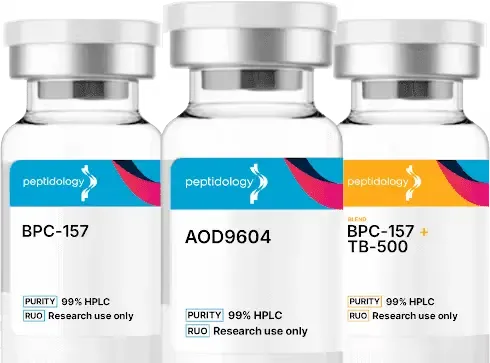
Three glass vials with labels for BPC-157, AOD9604, and a BPC-157 + TB-500 blend, marked for research use only.

Peptidology is best understood as a documentation-first research peptide supplier.


Its release standards are built around a more complete analytical record for each lot, including:


  • Identity and purity verification
  • Endotoxin testing
  • Heavy metal and elemental impurity screening
  • Dual-lab sterility or microbial contamination verification
  • Lot-specific Certificate of Analysis access

For researchers comparing vendors, this is the part worth focusing on. Many suppliers show a purity percentage. Fewer publish broader analytical data that helps evaluate contamination risk and batch-level consistency.

Featured Peptide Categories


Peptidology's catalog covers the most researched individual peptides in the space, including BPC-157, Ipamorelin, and others. Each individual compound clears the seven-procedure release battery with lot-specific certificate documentation, and most also carry the fourteen-procedure advanced panel.


Peptide Blends

Peptidology offers pre-formulated peptide blends designed to simplify multi-compound research protocols. Current offerings include:

  • KLOW Blend
  • GLOW Blend
  • CJC-1295 No DAC / Ipamorelin Blend
  • BPC-157 / TB-500 Blend
  • Thymosin alpha-1/Thymulin Blend


Blends are subject to the same analytical release standards as individual compounds, including purity, endotoxin, elemental impurity, and dual-lab microbial testing.


GLP Analytical Reference Materials

Peptidology carries GLP-grade analytical reference materials, a product segment less commonly found in the standard research peptide market. These are positioned for researchers operating within more technically demanding or regulated analytical workflows.


Need Help Choosing a Research Peptide Vendor?

Project Biohacking offers peptide coaching for researchers who want help comparing vendors, understanding documentation standards, and building more informed sourcing and protocol frameworks.


Learn more or to inquire about peptide consulting look into Project Biohacking's Peptide Coaching.


Peptidology review FAQ

  • What testing does Peptidology perform on each lot?

    A seven-procedure release battery on every lot, covering purity and assay by HPLC-UV/VIS, quantity, identity, endotoxins by LAL, heavy metals by ICP-MS against USP 232, and sterility confirmed by two independent laboratories. A fourteen-procedure advanced panel adds residual solvents by GC-MS across sixteen analytes, trifluoroacetic acid by ion chromatography, container closure integrity by dye ingress, solubility and conformity, and it covers roughly two thirds of the catalogue.

  • Who conducts Peptidology's third-party testing?

    Three laboratories appear in the certificate library. Vanguard Laboratory of Olympia, Washington and Eagle Analytical Services of Houston, Texas carry the routine release panel between them, both accredited to ISO/IEC 17025:2017 under A2LA certificate 6377.01.01. TrustPointe Analytics appears on a single document.

  • What purity does Peptidology report?

    99% or greater by HPLC. Across the two CJC-1295 No DAC lots published, the average was 99.55% with a range of 99.3 to 99.8 percent.

  • Does Peptidology test for sterility?

    Yes, by two complementary methods on every lot. A compendial USP test at Vanguard Laboratory and a ScanRDI rapid-detection method at Eagle Analytical Services. Both must pass before a lot ships.


  • How do I verify a Peptidology certificate?

    Scan the QR code on the vial. It resolves to the certificate for that specific batch. Confirm the lot number matches your vial and check the A2LA accreditation reference for the laboratory named.

  • Are Peptidology products safe for human use?

    No. All compounds are research materials sold for laboratory use only and are not approved for human or veterinary use.

Affiliate disclosure

Some links on this page are affiliate links, and Project Biohacking earns a commission when you order through one of them or use our code. That does not change your price.

Commission does not influence the criteria, the weightings or the scores. Every supplier in the directory is scored against the same four published criteria, and the full method is published on our rating methodology page.

This page is for educational purposes only and is not medical advice. Research compounds sold by Peptidology are for laboratory research use only and are not approved for human or veterinary use. Please consult a qualified healthcare provider before starting any peptide or supplement protocol.