
About the Author:
Jeff Nunn is the founder of Project Biohacking. With over 30 years of biohacking practice, he applies decades of self-experimentation methodology to peptide research, dosing math, and vendor evaluation.
How a GHRH analog targets deep belly fat, what it does for muscle and metabolic health, and what the research actually supports before you use it.
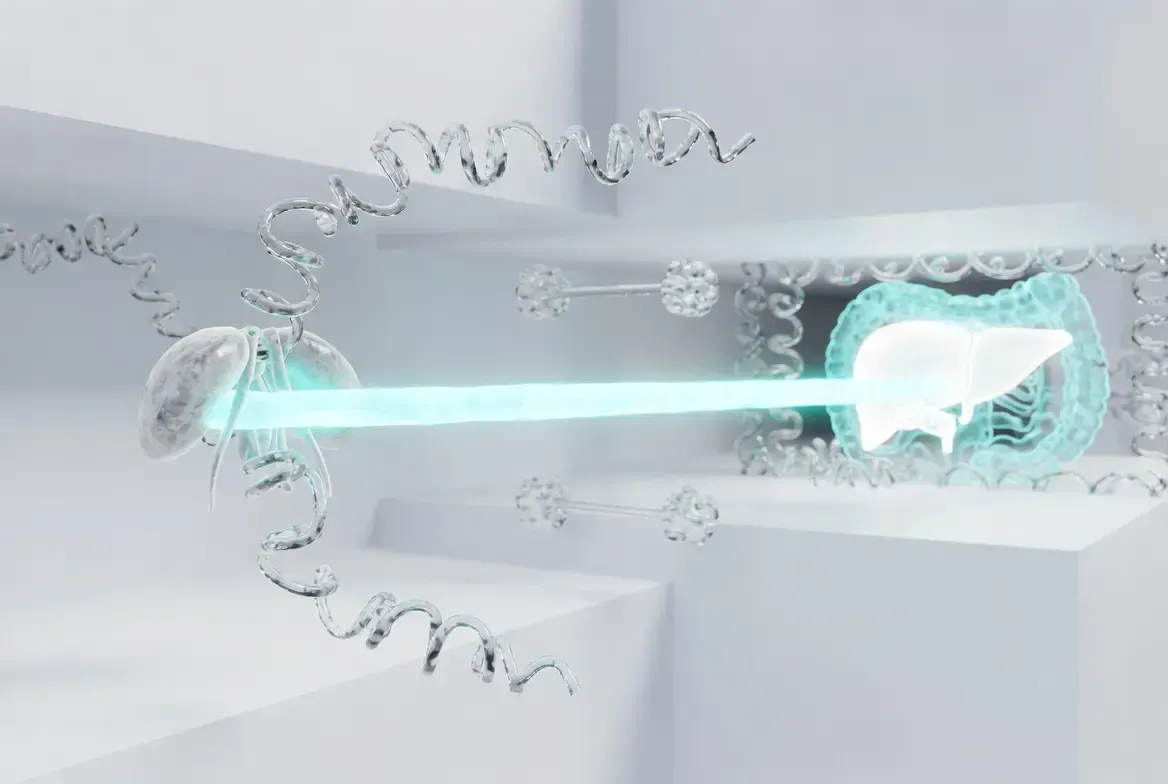
Tesamorelin peptide is a synthetic growth hormone-releasing hormone (GHRH) analog, a lab-made copy of the natural signal that tells your pituitary gland to release more growth hormone (GH). Its claim to fame is narrow and specific: it shrinks the deep belly fat packed around your organs, and it is the only peptide in its class with FDA approval for that job. This guide walks through how tesamorelin works, what it does for muscle growth and body fat, what the clinical research actually shows, the safety questions tied to diabetes and BMI, how it is used, and where it can be obtained legally.
A peptide is a short chain of amino acids that carries a specific message to specific cells, and your body already makes thousands of its own. If you want the ground-level primer, start with our guide to what peptides are. Tesamorelin belongs to a narrow group of these signals.
Tesamorelin is sold under the brand name Egrifta and is approved by the FDA to reduce excess abdominal visceral fat in HIV-infected adults with HIV-associated lipodystrophy, a condition that changes how the body stores fat. It is a prescription medication, and it is not approved as a general weight-loss drug for the wider population.
That target matters. Belly fat comes in two forms:
VAT is the riskier kind. It sits close to major organs and is tied to higher rates of heart and metabolic disease. Tesamorelin was built to go after this deep abdominal visceral fat rather than the soft fat near the surface, which is part of what sets it apart from most fat-loss approaches.
To see why tesamorelin lands so specifically on belly fat, it helps to follow the signal it sends.
When you inject tesamorelin, it binds to GHRH receptors on the anterior pituitary, the gland at the base of the brain, and mimics the body's own growth hormone-releasing hormone. That nudge tells the pituitary to release growth hormone in natural pulses. The extra GH then travels to the liver, which responds by making more insulin-like growth factor 1 (IGF-1), a hormone with both tissue-building and fat-handling effects.
This rise in GH and IGF-1 turns up lipolysis, the breakdown of stored fat, and it acts most strongly on visceral fat. The result you can measure on a scan is less fat packed around the organs. Two points are worth holding onto:
For a fuller look at the GH axis and how these signals play out in practice, see
how peptide therapy works.
With the mechanism in place, the next question is what those signals actually do to your shape and your numbers.
The strongest evidence sits with visceral fat. In the pivotal phase 3 trials published in the New England Journal of Medicine, HIV patients with central fat gain who used tesamorelin lost roughly 15 to 18 percent of their visceral fat over 6 to 12 months, while their subcutaneous fat barely moved. That selective pattern is the whole point: the deep fat with the most metabolic risk comes down, and the surface fat stays largely where it is.
Muscle is a softer story. The same GH and IGF-1 rise that mobilizes fat also supports muscle protein synthesis and nitrogen retention, which can help preserve or modestly add lean mass alongside training and good nutrition. But tesamorelin was never tested or approved as a muscle-building drug. Any effect on muscle is modest, training and diet still do the heavy lifting, and anyone selling it as a mass-builder is overselling it.
This is also where Body Mass Index needs a caveat. BMI is just weight divided by height squared, sorted into rough bands:
BMI is a blunt tool. It cannot tell muscle from fat, or deep visceral fat from the subcutaneous kind. Tesamorelin trials make this vivid: people often drop meaningful visceral fat while their BMI hardly changes, because the scale-weight shift is small even as body composition improves. Waist measurements, imaging where available, and metabolic labs paint a far clearer picture than BMI on its own.
Shrinking visceral fat is not just cosmetic, and that leads straight into what tesamorelin does to metabolic health and where its risks sit.
As visceral fat falls, several markers tend to improve. Trials and follow-up studies have linked tesamorelin's fat loss to better triglycerides and non-HDL cholesterol, and a separate randomized trial reported in JAMA found it also lowered liver fat in HIV patients with abdominal fat buildup. Those shifts point toward a better long-term cardiometabolic risk profile, though the long-range outcome data, things like heart attacks and lifespan, are still thin.
Blood sugar is the sensitive area. Growth hormone can blunt insulin sensitivity, so raising GH with tesamorelin can nudge blood glucose upward in some people. The approved label flags this directly:
The more common side effects are usually mild and tend to be:
The honest gap is time. Tesamorelin's track record is strongest over months in one specific patient group, and its long-term safety outside that group is not well mapped.
If the risk-and-benefit picture still points toward tesamorelin, the practical side comes down to how it is given and how to get it legally.
Tesamorelin is given as a small injection under the skin, taken once a day. The approved label sets a fixed daily dose and a powder that has to be mixed with a sterile diluent before use. This guide does not lay out a dosing or mixing protocol on purpose: reconstitution, dose, injection technique, and follow-up labs all belong with a licensed clinician who can match the drug to your health, order the right monitoring, and watch for problems.
Two realities shape access:
This is also the honest answer to where can I buy tesamorelin. Legitimate tesamorelin moves through pharmacies after a clinician signs off. Plenty of gray-market and research-only sites advertise it without a prescription, but those products are unregulated, often mislabeled or off on dose, and they skip the medical screening the drug really needs. If you are weighing any peptide bought this way, understand what
research peptides actually are and read up on
the FDA and peptides before you spend a dollar.
Tesamorelin rarely comes up alone in biohacking circles, so it helps to know how it sits next to the peptides people pair it with.
The most common pairing talked about is tesamorelin with ipamorelin. Ipamorelin is a growth hormone secretagogue, a peptide that triggers GH release through the ghrelin receptor rather than the GHRH receptor tesamorelin uses. Because the two hit different doors to the same room, the theory is that together they produce a bigger GH pulse than either alone. The catch is that human data on the combination are thin; most of the support is mechanistic and anecdotal, and the pairing is off-label.
CJC-1295 comes up too, but it is another GHRH analog, so stacking it with tesamorelin mostly doubles up the same pathway with little to gain. As a rule, pairing two GHRH analogs is redundant, while pairing a GHRH analog with a secretagogue is the logic behind most stacks. None of this is settled clinical practice, and combining growth hormone peptides only raises the stakes on side effects and cost. If you want to understand the broader logic of peptide stacks for body recomposition, treat tesamorelin as the studied anchor and everything bolted onto it as far less proven.
Sourcing any peptide safely starts with proof, not marketing. Project Biohacking tracks which research peptide vendors publish per-batch third-party testing and keeps verified coupon codes current, so you can check a source before you trust it.
See the Vendor Directory and Coupon Codes →
Is tesamorelin good for muscle growth? Indirectly, and modestly. By raising growth hormone and IGF-1, tesamorelin supports the signals behind muscle protein synthesis, which can help hold or slightly add lean mass with training. But it was studied and approved for visceral fat, not muscle building, and it is not a substitute for training, protein, and sleep.
How fast does tesamorelin reduce belly fat? In the main clinical trials, meaningful drops in visceral fat showed up over 6 to 12 months of daily use, with roughly 15 to 18 percent reductions in deep abdominal fat. It works gradually, not overnight, and the effect is concentrated on visceral fat rather than the fat just under the skin.
Does tesamorelin change your BMI? Often very little. Because tesamorelin targets deep visceral fat rather than total body weight, people can lose significant belly fat while their BMI barely moves. Waist size, imaging, and metabolic labs track its effect better than the scale.
Is tesamorelin safe if you have diabetes? It needs caution. Tesamorelin can raise blood sugar by lowering insulin sensitivity, so people with diabetes or prediabetes need closer monitoring of glucose and HbA1c and may need medication adjustments. Anyone with blood sugar concerns should clear it with a clinician first.
How does tesamorelin work? It is a GHRH analog. It binds receptors on the pituitary and prompts the gland to release growth hormone in natural pulses, which raises IGF-1 and steps up the breakdown of visceral fat. It does not add growth hormone directly; it boosts your own.
What is the best peptide to mix with tesamorelin? In informal use, ipamorelin is the one most often paired with it, since it raises GH through a different pathway. Evidence for the combination in humans is limited and off-label, and stacking two GHRH analogs like tesamorelin and CJC-1295 adds little. Any combination belongs under medical supervision.
Is tesamorelin available without a prescription? It should not be. Tesamorelin is a prescription medication approved only for HIV-associated lipodystrophy. Gray-market and research-only sellers offer it without one, but those products are unregulated and skip the medical screening the drug requires.
As a GHRH analog, it prompts the pituitary to release growth hormone in natural pulses, raising IGF-1 and increasing the breakdown of visceral fat.
The main effect of tesamorelin is reducing deep abdominal visceral fat, with little change to subcutaneous fat. As that visceral fat falls, studies report improvements in triglycerides, non-HDL cholesterol, and liver fat, which together support better metabolic health.
It raises growth hormone and IGF-1, which can modestly support lean mass with training, but it was approved for visceral fat reduction, not muscle building.
Clinical trials showed roughly 15 to 18 percent visceral fat loss over 6 to 12 months of daily use, concentrated on deep abdominal fat rather than surface fat.
Usually little, because it targets deep visceral fat rather than total body weight, so waist size and metabolic labs track its effect better than the scale.
It can raise blood sugar by lowering insulin sensitivity, so people with diabetes or prediabetes need closer glucose monitoring and clinician guidance.
Ipamorelin is the peptide most often paired with tesamorelin, since it raises growth hormone through a different pathway. The human evidence for the combination is limited and off-label, and stacking two GHRH analogs like tesamorelin and CJC-1295 adds little.
Yes, to reduce excess abdominal fat in HIV-infected adults with lipodystrophy. Bodybuilding, anti-aging, and general weight-loss uses are off-label.

About the Author:
Jeff Nunn is the founder of Project Biohacking. With over 30 years of biohacking practice, he applies decades of self-experimentation methodology to peptide research, dosing math, and vendor evaluation.
Important Disclaimer: The content on Project Biohacking is for educational and informational purposes only and is not intended as medical advice, diagnosis, or treatment. Always consult a qualified healthcare professional before making any changes to your health regimen, starting new supplements, peptides, or protocols. Nothing on this site establishes a doctor–patient relationship, and you use the information at your own risk. Research compounds discussed here are sold for laboratory research purposes only and are not approved for human or veterinary use or consumption.
“For educational use only. Not medical advice. Read our full disclaimer.”
+1 214-278-4039
All Rights Reserved | Project Biohacking