
About the Author:
Jeff Nunn is the founder of Project Biohacking. With over 30 years of biohacking practice, he applies decades of self-experimentation methodology to peptide research, dosing math, and vendor evaluation.
A 39-amino-acid peptide with FDA approvals across type 2 diabetes, weight management, sleep apnea, and cardiovascular risk, sold in a grey market where early testing data point to dose accuracy, not purity, as the weak spot.
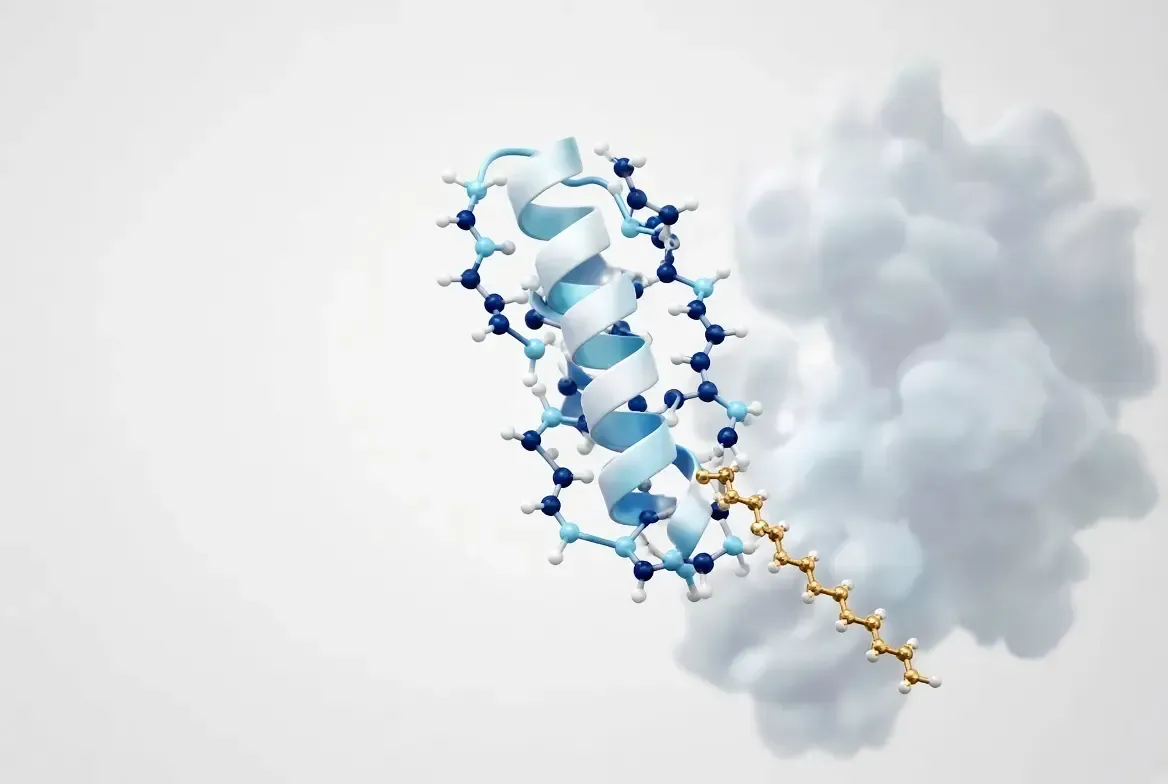
Tirzepatide is a synthetic peptide, 39 amino acids long, that switches on two gut hormone receptors at once: GIP and GLP-1 [1]. Interest in the tirzepatide peptide runs along two tracks that rarely meet. One is the approved drug, sold by Eli Lilly and Company as Mounjaro and Zepbound and backed by phase 3 trials with thousands of participants [2][3]. The other is research-labeled vials sold online, backed by a certificate and a disclaimer. The evidence behind the first does not transfer to the second.
Tirzepatide is a peptide: a single chain of 39 amino acids modeled on the hormone GIP, with a C20 fatty diacid (a 20-carbon fatty acid chain) attached so it binds albumin in the blood and holds a half-life of about 5 days [1][4]. Because the chain is 40 amino acids or shorter, the U.S. Food and Drug Administration regulates tirzepatide as a drug, not a biologic; FDA rules define a protein as a chain of more than 40 amino acids [5].
Three structural details matter:
Tirzepatide works by binding and activating the GIP receptor and the GLP-1 receptor, the two incretin receptors (receptors for gut hormones that boost insulin after a meal) [4]. Switching on both raises insulin release when blood glucose is high, lowers glucagon, slows stomach emptying, and reduces food intake, which together lower blood sugar and body weight [4].
Each effect lands on a different part of the body:
Selective GLP-1 agonists such as semaglutide act on only one of these receptors.
Tirzepatide is an imbalanced dual agonist: it binds the GIP receptor about as strongly as natural GIP, but binds the GLP-1 receptor about 5 times more weakly than natural GLP-1 [6]. In cell studies, tirzepatide's potency at the GLP-1 receptor, measured by cAMP signaling (the internal signal that drives insulin release), was about 20-fold lower than GLP-1's [6].
The same paper reported biased signaling at the GLP-1 receptor. Tirzepatide favors cAMP over beta-arrestin recruitment, a pathway that pulls receptors inside the cell and damps the response, and it drives less receptor internalization than GLP-1 does [6]. In isolated islet experiments, beta-arrestin limited the insulin response to GLP-1 but not to tirzepatide [6].
The authors' reading is that this imbalance delivers strong GIP signaling without pushing GLP-1 activity into the nausea range that often caps dose increases [6]. That is a mechanistic hypothesis built on cell and islet work. It fits the clinical results; it has not been shown to cause them.
Tirzepatide has outperformed semaglutide on glycated hemoglobin (HbA1c, a blood marker of average glucose over the past two to three months) and on body weight in head-to-head phase 3 trials, and in adults with type 2 diabetes and heart disease it was noninferior to dulaglutide on heart attack, stroke, and cardiovascular death [3][8][9]. The largest placebo-controlled weight result came from SURMOUNT-1, where adults with obesity and without diabetes lost an average of 15.0%, 19.5%, and 20.9% of body weight at 5, 10, and 15 mg over 72 weeks, compared with 3.1% on placebo [10].
| Trial | Population and length | Comparator | Main result | Design limit |
|---|---|---|---|---|
| SURPASS-2 (2021) | Type 2 diabetes on metformin; 40 weeks | Semaglutide 1 mg | HbA1c −2.01, −2.24, and −2.30 points at 5, 10, and 15 mg vs −1.86 points | Open-label; semaglutide dose below the weight-loss dose |
| SURMOUNT-1 (2022) | Obesity or overweight without diabetes; 72 weeks | Placebo | Body weight −15.0%, −19.5%, and −20.9% vs −3.1% | No active comparator |
| SURMOUNT-5 (2025) | 751 adults with obesity, no type 2 diabetes; 72 weeks | Semaglutide 1.7 or 2.4 mg | Body weight −20.2% vs −13.7% | Open-label |
| SURPASS-CVOT (2025) | 13,299 adults with type 2 diabetes and atherosclerotic cardiovascular disease; median about 4 years | Dulaglutide 1.5 mg | Cardiovascular death, heart attack, or stroke: 12.2% vs 13.1%; hazard ratio 0.92 | Noninferior; superiority not established |
Sources: SURPASS-2 [8]; SURMOUNT-1 [10]; SURMOUNT-5 [9]; SURPASS-CVOT [3][11]
The trial programs line up with the approvals. SURPASS supported Mounjaro for type 2 diabetes mellitus in May 2022, SURMOUNT supported Zepbound for weight management in November 2023, and Zepbound added obstructive sleep apnea in adults with obesity in December 2024 [12][13]. Mounjaro is now labeled for type 2 diabetes in adults and in children 10 and older [3].
Averages also hide the range. In SURMOUNT-5, 19.7% of people taking tirzepatide lost at least 30% of their body weight, compared with 6.9% on semaglutide [14], which also means most participants on tirzepatide landed below that mark. For how tirzepatide sits among other compounds studied for fat loss, see
peptides for weight loss.
Tirzepatide beat semaglutide in its two major head-to-head trials, though the size of the edge depends on the outcome and the doses compared. In SURPASS-2, all three tirzepatide doses lowered HbA1c more than semaglutide 1 mg over 40 weeks, by 0.15 to 0.45 percentage points [8]; in SURMOUNT-5, tirzepatide produced 20.2% average weight loss against 13.7% for semaglutide over 72 weeks [9].
Both trials were open-label, so participants knew which drug they were taking [8][9]. SURPASS-2 also used the 1 mg semaglutide dose rather than the higher doses used for weight management, which matters when reading its weight results. SURMOUNT-5 closed that gap by testing semaglutide up to 2.4 mg.
Tirzepatide, as Mounjaro, is FDA-approved to lower the risk of cardiovascular death, heart attack, and stroke in adults with type 2 diabetes at high risk for these events, an approval Eli Lilly announced on August 28, 2026 [3]. The approval rests on SURPASS-CVOT, where tirzepatide was noninferior (not meaningfully worse, by a preset margin) to dulaglutide, a GLP-1 drug with proven cardiovascular benefit, with an 8% lower event rate that did not reach statistical superiority [3].
SURPASS-CVOT enrolled 13,299 adults with type 2 diabetes and established atherosclerotic cardiovascular disease, meaning plaque inside artery walls had already caused a diagnosed problem, and followed them for a median of about 4 years [3]. The main endpoint occurred in 12.2% of the tirzepatide group and 13.1% of the dulaglutide group [11].
Tirzepatide lowers several markers linked to atherosclerosis, including triglycerides, apolipoprotein B, small LDL particles, systolic blood pressure, and C-reactive protein, though better markers do not by themselves prove fewer heart attacks [17][18]. The marker data explain part of the cardiovascular picture; outcome trials such as SURPASS-CVOT are what test it.
Tirzepatide's most common side effects are nausea, diarrhea, decreased appetite, vomiting, constipation, indigestion, and stomach pain [3]. In SURPASS-CVOT, these gastrointestinal effects were mostly mild to moderate and showed up mainly during the dose-escalation period, the weeks when the dose is being stepped up [3].
The label also carries serious warnings [3][4]:
The label describes a known molecule at a known strength, which is exactly what a research vial cannot guarantee.
A tirzepatide research peptide is freeze-dried (lyophilized) tirzepatide powder sold online outside the FDA-approved supply chain, usually labeled "for research purposes" or "not for human consumption." The FDA says it has warned companies that sold unapproved tirzepatide with those labels directly to consumers for human use, and it urges consumers not to buy these products because their quality is unknown [21].
The disclaimer does less legal work than the label implies. In seven warning letters published in April 2026, the FDA judged intended use from each seller's whole website, so product pages describing appetite suppression, weight loss, or glucose effects counted as evidence of a drug meant for people [22]. The same FDA statement lists
retatrutide, Eli Lilly's investigational triple agonist, among the compounds sold this way [21]. For what the label means in practice, see
research only peptides.
Compounded tirzepatide is a separate category. Pharmacies could compound it while tirzepatide was in national shortage; the FDA declared that shortage resolved on December 19, 2024, and the grace periods for state-licensed pharmacies and outsourcing facilities ended in early 2025 [23]. On April 30, 2026, the FDA proposed keeping tirzepatide off the list of bulk substances outsourcing facilities may compound from, citing no clinical need outside a shortage [24]. More on how that channel works is in
compounding pharmacy peptides.
Project Biohacking compared the three ways tirzepatide reaches people: the FDA-approved drug, compounded versions, and research-labeled vials.
| Attribute | FDA-approved (Mounjaro, Zepbound) |
Compounded tirzepatide | Research-labeled tirzepatide |
|---|---|---|---|
| Status for human use | Approved prescription drug | Shortage-based compounding ended after the December 2024 shortage resolution | Not approved for human use; FDA has issued warning letters to sellers |
| FDA quality review before sale | Yes, as part of approval | No; FDA does not review compounded drugs before they are marketed | No |
| Who makes it | Eli Lilly and Company under its approved application | State-licensed pharmacy or outsourcing facility | Synthesis source undisclosed or declared only by the seller |
| Form | Fixed-strength pens and vials, 2.5 to 15 mg per dose | Varies by pharmacy, including multi-dose vials | Lyophilized powder in vials; labeled amount not independently confirmed at sale |
| Quality and safety signals | Label safety data from phase 3 trials and ongoing reporting | More than 730 FDA adverse event reports as of May 31, 2026 | In one preprint dataset, 13.8% of samples met strict purity and dose-accuracy criteria together |
Sources: [21][23][3][20][25]
Independent testing data on tirzepatide research peptides point to dose accuracy, not purity, as the most common failure. In a 2026 preprint (a study not yet peer reviewed) analyzing public Finnrick Analytics test results, only 13.8% of tirzepatide samples met both a 99.5% HPLC purity cutoff and a label-dose window of 95% to 105%, while 58.8% passed on purity but missed on how much tirzepatide the vial actually held [25].
Two lab measurements explain that gap:
Other findings from the same analysis [25]:
Dose accuracy matters more than any single purity number. If a vial marked 10 mg actually holds 12 mg, anyone relying on that label gets 20% more tirzepatide than they think, and nothing about the vial reveals it. The FDA has already received adverse event reports that may be tied to compounded tirzepatide used at doses beyond the approved label [21]; for how dosing errors happen and which symptoms warrant care, see
peptide overdose risk. A certificate of analysis that reports purity with no quantity result and no endotoxin result leaves both failure modes above unmeasured.
Tirzepatide's label warnings are easier to judge alongside the rest of its drug class. The Project Biohacking
GLP-1 risk calculator covers safety considerations and reported side effects for GLP-1 medications, including tirzepatide and semaglutide, with risk factors drawn from published research. It is an educational tool and does not replace a prescriber's assessment.
Tirzepatide works on two receptors: the GIP receptor (glucose-dependent insulinotropic polypeptide) and the GLP-1 receptor (glucagon-like peptide-1) [4]. It is imbalanced toward GIP, binding that receptor about as strongly as natural GIP while binding the GLP-1 receptor about 5 times more weakly than natural GLP-1 [6].
Tirzepatide side effects, mainly nausea, diarrhea, vomiting, and constipation, tend to show up during the dose-escalation period, when the dose is being increased. In the SURPASS-CVOT trial, Eli Lilly reported that gastrointestinal events were generally mild to moderate and occurred primarily during escalation [3]. Severe stomach pain that does not go away is a label warning sign for pancreatitis.
Tirzepatide has an elimination half-life of about 5 days, which is why it is given once a week [4]. As a general pharmacokinetic rule, a drug takes about five half-lives to clear almost entirely, which puts tirzepatide at roughly 25 days after the last dose. The label cites the same 5-day half-life when describing how long to observe someone after an overdose [4].
Research-grade tirzepatide shares a molecule name with Mounjaro and Zepbound, but it is not the same product. It has had no FDA review for quality or safety, the FDA urges consumers not to buy it [21], and in one 2026 preprint dataset only 13.8% of tirzepatide samples met strict purity and dose-accuracy criteria together [25].
Tirzepatide, sold as Mounjaro, is approved to lower the risk of cardiovascular death, heart attack, and stroke in adults with type 2 diabetes at high risk for those events, an approval Eli Lilly announced on August 28, 2026 [3]. It followed SURPASS-CVOT, in which tirzepatide was noninferior to dulaglutide. The indication does not cover people without type 2 diabetes.
Tirzepatide is a GLP-1 receptor agonist and a GIP receptor agonist in one molecule, so it is usually called a dual agonist rather than a GLP-1 agonist alone [4]. That dual activity separates it from semaglutide, liraglutide, and dulaglutide, which act only on the GLP-1 receptor.
Tirzepatide had no approved generic as of Sandoz's June 29, 2026 announcement that the FDA had accepted two abbreviated new drug applications for generic tirzepatide for review [2]. The FDA's standard process allows up to 10 months to decide on such applications, and acceptance for review is not approval [2].

About the Author:
Jeff Nunn is the founder of Project Biohacking. With over 30 years of biohacking practice, he applies decades of self-experimentation methodology to peptide research, dosing math, and vendor evaluation.
Important Disclaimer: The content on Project Biohacking is for educational and informational purposes only and is not intended as medical advice, diagnosis, or treatment. Always consult a qualified healthcare professional before making any changes to your health regimen, starting new supplements, peptides, or protocols. Nothing on this site establishes a doctor–patient relationship, and you use the information at your own risk. Research compounds discussed here are sold for laboratory research purposes only and are not approved for human or veterinary use or consumption.
“For educational use only. Not medical advice. Read our full disclaimer.”
+1 214-278-4039
All Rights Reserved | Project Biohacking